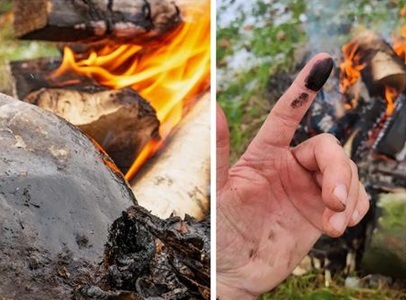
Researchers used methods that Neanderthals also used to produce birch tar and to analyze its antibacterial properties. Credit: Tjaark Siemssen
In a new study, researchers used the same methods that Neanderthals used to produce birch tar in order to analyze its antibacterial properties. The results indicate that Neanderthals may have used birch tar not only as an adhesive to assemble tools, but also to treat wounds.
Birch tar is a viscous substance extracted from birch bark and is commonly found on Neanderthal archaeological sites in Europe. As birch tar residues are often found attached directly to stone artifacts, archaeologists long assumed that it was mainly used as an adhesive for hafting. However, new studies suggest that birch tar may also have been used for other purposes.
For the study, published in PLOS One, the researchers extracted tar experimentally from birch species that existed during the Neanderthal era. They specifically employed extraction methods reconstructed from Neanderthal contexts.
In one process, for example, birch bark was burned underground in a sealed pit. The absence of oxygen results in a dry distillation, extracting the birch tar from the bark. Another method involved burning birch bark next to a hard surface so the tar condenses on the surface of the stone.
The team then tested the birch tar samples they had collected to investigate their antimicrobial properties. All of the tar samples were found to be effective at hindering the growth of Staphylococcus aureus bacteria.
“The findings suggest that antimicrobial properties played a role as far back as the time of the early Neanderthals and could have been used in a targeted manner,” said lead author Tjaark Siemssen of the University of Cologne and Oxford University. “Our findings show that it might be worthwhile to examine targeted antibiotics from ethnographic contexts—or as in this case, from prehistoric contexts—in greater depth.”
Data from University of Cologne