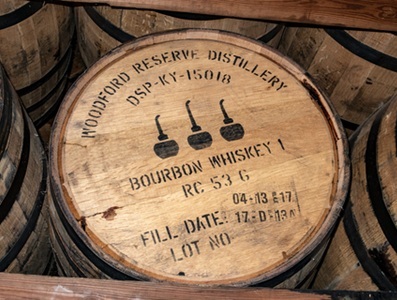
Did you know the state of Kentucky produces 95% of the world’s bourbon? But once all that liquid is bottled, distilleries are left with an enormous amount of waste grain, called stillage. While stillage is typically sold to farmers as livestock feed or a soil additive, it is difficult and expensive to transport.
“From the final volume of bourbon produced, you get 6 to 10 times that amount of stillage as waste, so it's a big deal,” said Josiel Barrios Cossio, a graduate student who presented the work at the American Chemical Society’s Spring show this week.
Now, researchers at the University of Kentucky have developed an alternative solution to turn this bourbon byproduct into supercapacitors that can store more energy than current commercial devices.
For their study, Barrios Cossio and team transformed the stillage into a fine black powder by treating the waste product with heat and pressure in a 10-L reactor. From there, the black powder was heated to 392Fahrenheit, either on its own to form hard carbon or with potassium hydroxide to 1,472 F to form activated carbon.
Hard carbon is like graphite but with carbon sheets that are less neatly stacked, which makes it ideal for adsorbing more lithium ions to boost energy storage capability. Activated carbon is extremely porous, meaning it can store large amounts of charge—and therefore energy—within its large internal surface area.
For a proof-of-concept, the team made double-layer capacitors by sandwiching a liquid electrolyte between activated carbon electrodes. In tests, these coin-sized supercapacitors could store up to 48 watt hours per kilogram, which was on par with commercially available ones.
The researchers also experimented with hybrid lithium-ion supercapacitors, which are designed to compromise between the fast discharge speeds of capacitors and the higher energy storage of batteries. So, they built devices with one capacitor-type activated carbon electrode and one battery-type hard carbon electrode, which were both infused with lithium ions. These stillage-derived supercapacitors stored up to 25 times the energy per kilogram as conventional versions.
“It was a huge discovery that you can make hybrid devices from this waste,” said Barrios Cossio. “Hybrid devices are not common and not easy to make.”
The researchers' next steps are to study the energy storage mechanisms of their stillage-derived supercapacitors to optimize them for commercialization.
The team says their long-term goal is to develop larger versions of the supercapacitors so the technology could help stabilize the electrical grid as more renewable energy sources are incorporated.