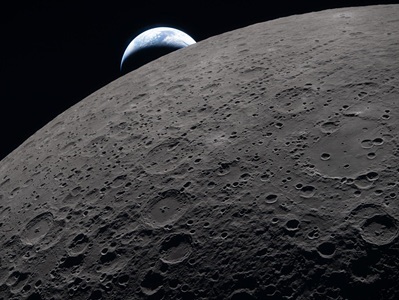
In this photo snapped from the Orion spacecraft, the lunar surface fills the frame during the lunar flyby, while a distant Earth sets in the background. This image was captured at 6:41 p.m. EDT, on April 6, 2026, just three minutes before the Orion spacecraft and its crew went behind the Moon and lost contact with Earth for 40 minutes before emerging on the other side. In this image, the dark portion of Earth is experiencing nighttime, while on its day side, swirling clouds are visible over the Australia and Oceania region. In the foreground, Ohm crater shows terraced edges and a relatively flat floor marked by central peaks—formed when the surface rebounded upward during the impact that created the crater. (Image Credit: NASA)
On Monday evening, the Artemis II crew came within about 4,067 miles of the Moon’s surface, becoming the first humans to see some parts of the far side of the Moon.
During the lunar flyby, a fleet of cameras on the spacecraft helped capture imagery of the Moon, including features humans have never directly seen. The astronauts also used a variety of digital handheld cameras to grab high-resolution photos of the lunar surface.
Photos, videos, mission telemetry, and communication information from the flight will be used to inform future Artemis missions as NASA embarks on development of its Moon Base. Under the Artemis program, NASA will send Artemis astronauts on increasingly challenging missions to explore more of the Moon for scientific discovery, economic benefits, and to build on the foundation for the first crewed missions to Mars.
See more Artemis II multimedia here.