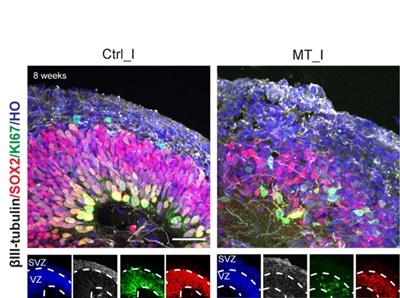
The scientists studied brain organoids derived from patients suffering from a newly discovered genetic disease. These organoids had a more disorganized structure and fewer properly patterned developing nerve cells than healthy controls, suggesting impaired brain development. Credit: Fang Yuan, Su-Chun Zhang, Sanford Burnham Prebys.
Scientists at Sanford Burnham Prebys Medical Discovery Institute have discovered a new rare genetic disease that interferes with brain development.
In the new study published in Human Genetics and Genomics Advances, researchers sequenced the genomes of two siblings suffering from an unfamiliar neurodevelopmental disorder. They found a mutation shared by the two affected siblings but not by three other siblings who show no signs of the disease. The genetic error had not been reported in any large public database used by geneticists to share information.
These results sharpened the scientists’ focus on a mutation in the RPN1 gene. This gene carries the blueprints for building a protein called ribophorin I. Because of this protein’s role in glycosylation, the team conducted a biochemical test used to diagnose patients with congenital disorder of glycosylation (CDG) diseases by assessing if proteins are being properly adorned with sugar molecules.
“The glycosylation results from these tests reflected patterns we know well from other congenital disorder of glycosylation diseases,” said Hudson Freeze, director of the Sanford Children’s Health Research Center at Sanford Burnham Prebys. “After confirming that this was a new CDG, the next step was to better understand why it was occurring.”
The protein affected by the newly identified mutation—ribophorin I—is an essential component of the complicated biological machinery responsible for glycosylation. Multiple proteins, including ribophorin I, combine to form two varieties of a cellular factory known as the oligosaccharyltransferase (OST) complex. These conjoined proteins work in concert to decorate freshly constructed proteins with the appropriate sugar molecules.
The research team found that the mutation lopped off part of ribophorin I, leading to protein instability in the OST complex. The truncation of ribophorin I also caused a unique deficit in one of the two subtypes of OST complex called OST-A. This structural defect caused a reduction in the attachment of sugars to many proteins OST-A is meant to glycosylate.
“Because the OST complex plays a role in every developmental process, that is why we see a range of neurodevelopmental and other developmental issues in CDGs,” said Freeze.
By defining and studying this new disease—now termed RPN1-CDG—the scientists have expanded the number of genes associated with OST complex diseases to eight. A better understanding of the new disorder and all CDGs will help provide definitive diagnoses to more patients suffering from rare diseases.
Data from Sanford Burnham Prebys Medical Discovery Institute