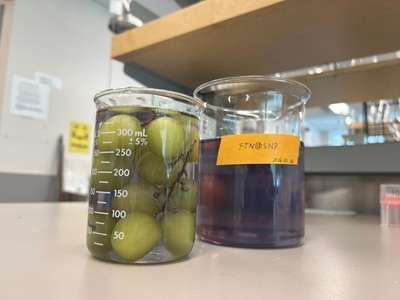
New wash removes pesticides and extends produce shelf life. Credit: Sachi Wickramasinghe/UBC Media Relations
Rising food prices are taking a toll on American wallets. That’s one reason why it’s so frustrating to bring home apples that turn brown the next day or grapes that crinkle in a few hours. Additionally, while pesticide levels on fruits and vegetables are tightly regulated, trace residues often remain—and these traces can exceed recommended limits when a whole carton of berries is eaten at once, the way kids tend to do.
Now, researchers at the University of British Columbia have developed a solution for both problems—a natural, biodegradable wash that not only removes up to 96 percent of pesticide residue from fruit but also slows browning and moisture loss.
The new wash uses tiny particles made from starch capped in iron and tannic acid. Tannic acid is the plant compound that gives tea and wine their dry taste. When iron and tannic acid join together, they form sticky, sponge‑like clusters that can grab onto pesticides and lift them.
In the study, published in ACS Nano, the researchers tested the wash by applying three commonly used pesticides to apples at typical, real-world concentrations of about 10 milligrams per liter. Results showed the wash removed between 86 and 96 percent of the pesticides. Rinsing with tap water, baking soda or plain starch typically removes less than half.
After washing, the fruit was dipped in the solution again to form a light edible, biodegradable layer. The study showed fresh‑cut apples treated with the coating browned much more slowly and lost less water over two days in the fridge. Meanwhile, whole grapes stayed plump for 15 days at room temperature, compared with noticeable shriveling in untreated grapes.
“The coating acts like a breathable second skin,” said study author Tianxi Yang, assistant professor in UBC’s faculty of land and food systems. “Measures of food quality like acidity and soluble sugars also remained higher in coated fruit.”
Yang and team note the coating also showed some antimicrobial effects.
Because the ingredients are inexpensive and mixed using water, the researchers say the wash could be scaled easily for industry use. The team is now working on refining, scaling and testing the formula for use in commercial processing facilities, where fruit is cleaned before shipping.
“Our early cost estimates suggest it would add roughly 3 cents per apple—comparable to current commercial coatings, but with the added benefit of pesticide removal and extending shelf life,” said Yang.
The team also sees potential for a home version.
“Imagine a spray or tablet you could add to water right before washing your fruit,” said Yang.
More testing is needed before household use, including regulatory review and real‑world studies with different fruits and washing habits.
Overall, the researchers hope to help people feel confident about the produce brought home—it’s safer, lasts longer and creates less waste.