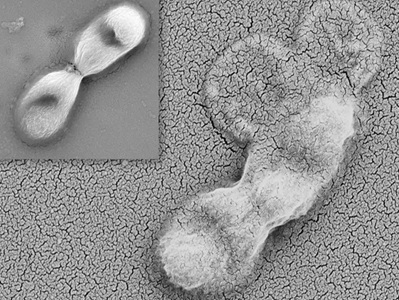
An antibiotic-resistant bacterium (Escherichia coli) is treated with an antibiotic (colistin) and a DsbA inhibitor, causing it to rupture and, eventually, die. The work highlights a new strategy that aims to eradicate multidrug-resistant pathogens. Credit: Nikol Kadeřábková
As if dangerous pathogens being resistant to antibiotics isn’t enough of a crisis, previous research has shown certain pathogens can actually “shield” other strains when antibiotics are present, a process known as cross-protection or cross-resistance.
Now, researchers at the University of Texas at Austin have discovered a mechanism that renders antibiotic-resistant bacteria vulnerable by disabling both their individual resistance and their cross-protection.
While this project focused on cystic fibrosis-associated bacteria, the findings could translate to a broad range of antibiotic-resistant infections since similar bacterial survival mechanisms are found across many species.
In the new study, published in eLife, researchers studied synthetic polymicrobial communities of Pseudomonas aeruginosa and Stenotrophomonas maltophilia. The team chose to examine both bacteria as the majority of clinical infections contain multiple species that resist treatment in different ways. It’s this coexistence that gives rise to complex interactions, including cross-protection.
Ultimately, the team chose this approach as it more closely mimics the challenges of treating real cystic fibrosis-related lung infections as opposed to previous studies that focus on a single pathogen grown in isolation.
P. aeruginosa is the most prevalent organism in cystic fibrosis lung infections, and treatment relies heavily on β-lactam antibiotics, a class that includes drugs such as penicillins and cephalosporins. In contrast, S. maltophilia is increasingly detected in cystic fibrosis microbiomes and is resistant to nearly all antibiotics, including β-lactams. Problematically, S. maltophilia’s cross-protection has been experimentally shown to promote the evolution of β-lactam–resistant P. aeruginosa strains, further complicating treatment.
To counter these interactions, the researchers targeted a protein-folding system that is essential for resistance enzymes to function. The team found that deleting the gene from bacterial genomes deactivated resistance enzymes and sensitized both P. aeruginosa and S. maltophilia to antibiotics. They then showed that the same effect could be achieved using chemical inhibitors, demonstrating that antibiotic resistance can be reversed without genetic modification. This highlights a potential pathway for new drug development.
“By targeting the protein-folding system these pathogens rely on to build their resistance enzymes, we may be able to develop a new class of therapies that work alongside standard antibiotics, restoring their effectiveness and helping clinicians treat infections that are currently very difficult to manage,” said study co-author Despoina Mavridou, assistant professor of molecular biosciences at University of Texas.