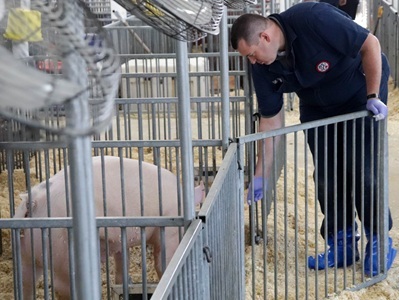
The influenza D viruses from pigs used in the study were collected as part of long-term surveillance for swine flu at county and state fairs led by co-author Andrew Bowman. Credit: The Ohio State University College of Veterinary Medicine
Researchers at Ohio State University have discovered that influenza D virus, most often found in cattle, can make copies of itself in human cells and lung tissue samples. These findings suggest the virus—which has mostly flown under the radar since its detection in cattle in 2011—has strong potential to spill over to humans.
“This is an opportunity, if we are indeed in front of it, to invest in surveillance and basic understanding of its biology such that we could be prepared if it were to emerge in the future,” said lead author Cody Warren, assistant professor of veterinary biosciences at Ohio State University.
Warren did not set out to study how influenza D in human cells. Initially, he was analyzing samples collected from pigs at county and state fairs as part of long-term surveillance for swine flu—a type A influenza virus. However, influenza D get popping up in the samples.
“The currently held belief is that bovines are the natural host for flu D. So, pigs may be a secondary host, or not. The fact that it was in pigs is something we were trying to understand: Is that a potential pathway for the virus to adapt into a more transmissible virus in humans?,” said Andrew Bowman, professor of veterinary preventive medicine at Ohio State, and leader of the swine flu surveillance project.
Investigating further, researchers tested influenza D’s replication in cells that mimic the human airway by differentiating patient-derived lung epithelial cells at the air-liquid interface. The virus started to grow just as well as influenza A.
The team then compared the growth of influenza types D and A in human and swine lung tissues, finding that both virus types replicated efficiently.
But, experiments in cells and tissue showed a key difference between the two flu types: Influenza D, despite growing well, did not stimulate a robust antiviral immune response in infected cells, while influenza A virus did.
Separate tests in cell cultures showed influenza D growth was restricted if the cells were first primed by the protein interferon, suggesting that human cells have potent mechanisms to restrict viral infection.
In infected animals, influenza D generates respiratory symptoms that cattle and pigs recover from, suggesting their immune systems are at work fending off the infection. In humans, most viral infections trigger the release of interferon, which produces inflammation and raises body temperature, leading to symptoms.
These findings prompt important questions: Could humans have been infected but not felt sick, meaning influenza D is not a serious health risk? Or is it so stealthy that it can hide from the immune system, leaving us unable to put up a fight?
“Those are gaps that we don’t quite understand,” Warren said. “The virus replicates to really high levels but doesn’t elicit a robust interferon response. Would it behave differently in the body of a person versus in these cell- or tissue-based systems?”
Bowman has collected many more influenza D viruses from pigs through ongoing swine flu surveillance, and plans to analyze the samples to assess whether the viruses are changing and if so, how.
“Causing disease in some host species makes us somewhat concerned about what it might do in humans,” said Bowman. “It may not cause disease in this particular form, but in an evolved form, there may be that potential.”