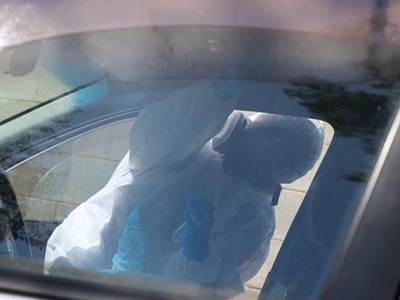
Methamphetamine can be manufactured in vehicles in transportable and generally small-scale clandestine laboratories. Credit: Flinders University
Researchers have found that ventilation can reduce—but not completely remove—methamphetamine contamination on most hard surfaces of a car, even after an extended period of time.
While the study mostly has implications for law enforcement, vehicle dealers and lenders, and second-hand car owners, it sheds more light on the complexity of drug contamination in contained spaces with different fabric types. This includes household upholstery, HVAC units, and other hard, soft and even textile surfaces.
For the study, published in Forensic Chemistry, researchers at Flinders University team conducted controlled emissions of methamphetamine smoke in a car with no known prior contamination.
After three smoking events, there was a general concentration increase on the car surfaces, on four fabric types placed on the car seat and seat backrests and in the sampled air. The highest surface concentrations were reported on the space over the driver’s head—likely due to rising smoke.
Meanwhile, the highest methamphetamine concentrations were observed from cotton and faux leather, with the lowest concentrations from polyester and neoprene fabrics. For cotton, faux leather and neoprene fabrics, lower concentrations were reported in the seat back when compared with the seat.
According to the study results, air concentrations ranged from 0.19 to 0.96 micrograms per cubic meter in the driver area and the rear storage area after three controlled smokes. For comparison purposes, tobacco smoke can contain hundreds of thousands of micrograms per cubic meter of airborne particles in indoor environments.
After the researchers performed their analysis, they opened the car’s windows for ventilation decontamination. Overall, concentrations of meth in the air and on surfaces decreased after 8 weeks of venting—but did not completely disappear. Additionally, some fabric concentrations actually showed a slight increase after the ventilation period. The research team believes this may have occurred because of the relatively high temperatures inside the car during the venting period, volatizing the drug and resulting in transfer.