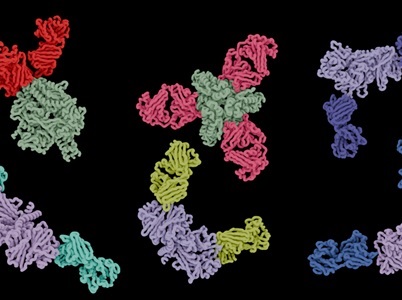
These renderings show proteins from the measles virus (in the center of each structure) bound with neutralizing human antibodies (attached to sides of the viral proteins). These high-resolution structures show where the human immune system can target the measles virus. Credit: Dawid Zyla, La Jolla Institute for Immunology
Scientists at La Jolla Institute for Immunology (LJI) are the first in the world to characterize human antibodies capable of neutralizing measles virus. These antibodies bind to key sites on measles virus and prevent the virus from entering host cells.
Until recently, enough people were vaccinated against the measles virus that the risk of exposure for unvaccinated persons was very low. Now, “herd immunity” is no longer. With so many people choosing to not receive the measles vaccine, this new study shows monoclonal antibody therapies may be the way forward.
For the study, researchers used cryo-electron microscopy to capture the first-ever glimpses of how antibodies bind to the measles virus. The results showed—in stunning detail—where measles virus is vulnerable to antibody attack. The mouse antibodies latched onto one key part of the measles virus, called the fusion protein, to block the virus from entering a host cell.
To find out if human antibodies do the same, researchers analyzed blood from a clinical research volunteer. This volunteer had been vaccinated against measles many years before, so they already had antibodies.
From this one blood sample, scientists isolated antibodies that bind to the measles fusion protein, and other antibodies that bind to the second key piece of the virus, an attachment protein called “H.” They then captured 3D images of these antibodies bound together with the measles virus.
Study collaborators then carried out experiments using cotton rats as a model. They found that all four lead antibodies reduced the viral load when given either before measles exposure or within 24 to 48 hours after infection. One, an antibody called 3A12, which binds to a site on the F protein, rendered the circulating virus actually undetectable.
Ultimately, the study showed that antibodies targeting the fusion protein work by locking the protein in place, leaving the virus unable to shape shift and infect a host cell.
While more work needs to be done, the researchers see these antibodies as promising tools in the fight against measles.
“Now we know what we're aiming for, and we have the antibodies we need,” said LJI professor, president & CEO Erica Ollmann Saphire, who led the study.
Data from La Jolla Institute for Immunology