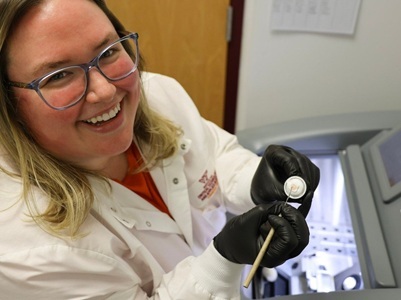
Megan Sweet, biological sciences graduate student. Photo by Kelly Izlar for Virginia Tech.
Most normal cells in your body are diploid, meaning they have two copies of each chromosome—one set from each parent. To stay healthy, a diploid cell divides to make more diploid cells. But occasionally, a dividing cell makes a mistake, which throws off the chromosome numbers. And then, that mistake is replicated and starts to accumulate. This is one of the ways diseases like cancer can form.
Biologists Megan Sweet, Daniela Cimini and Mat Bloomfield have spent the past five years analyzing cells with abnormal chromosome numbers—one of the proverbial smoking guns of cancer.
To create the right environment for their studies, Cimini’s research group members forced diploid cancer cells to duplicate their chromosomes but skip division. This resulted in what’s called a tetraploid cell, which has four complete sets of chromosomes, and makes cancer so much worse.
The researchers compared tumors formed from diploid cancer cells with tumors formed from tetraploid cancer cells. They found that the number of tetraploid cells diminished during tumor formation in mice, and yet tumor mass ballooned fast and large. The growth, the researchers discovered, was driven by the recruitment of stromal cells.
Then, when Bloomfield made human-derived cancer cells tetraploid and isolated single-cell clones, he noticed something unexpected: the cells from the first few clones differed in size. The team anticipated all the clones to be two times larger, but some were 25 to 30 percent smaller than—and the smaller clones were more tumorigenic than the larger clones.
Additional experiments in mice showed that tumors with smaller tetraploid cells often increased more rapidly. Moreover, results did not depend on cancer cell type—they saw the same behavior in colorectal and breast cancer.
Turning to human studies, using data from the Cancer Genome Atlas, the researchers found smaller tetraploid cells from several cancer types were indeed associated with worse prognosis and lower survival rates.
Next steps include a deeper investigation into the mechanisms behind these findings and continued analysis of human cancer data.
Data from Virginia Tech