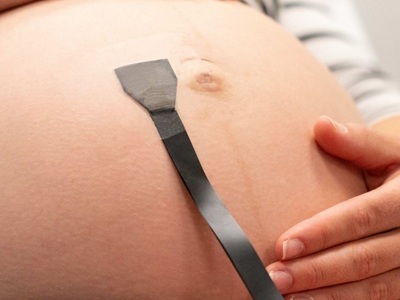
Researchers have developed a wearable patch to monitor high-risk pregnancies. It connects to a computer that interprets ultrasound data. Credit: Sheng Xu via Stanford Medicine
Current fetal monitoring tools for physicians to closely follow high-risk pregnancies are inadequate, only showing fetal snapshots in small increments of time.
To address this challenge, researchers in California developed a wearable ultrasound patch that adheres to a patient’s abdomen to provide continuous, real-time information about blood flow in the fetus and umbilical cord.
“Umbilical artery blood flow is one of the components we look at closely when we’re concerned about fetal well-being,” said Jane Chueh, MD, a high-risk obstetrician at Stanford Medicine who will be collaborating on further validation of the technology. “Right now, for high-risk pregnant patients, it can be hard for physicians to get the information we want, right when we need it. I think this device will be able to give us that information much more easily.”
The device’s design has been tested and validated in several dozen pregnant patients already.
Overcoming challenges
The ultrasound patch is a flexible adhesive sticker—about the size of the palm of a hand— that adheres to the abdomen. It is connected to a computer that interprets ultrasound data. The researchers think the patch will initially be used for pregnant women who are hospitalized, but they hope eventually to have a wireless version that enables doctors to monitor patients at home.
In developing the patch, the researchers had to overcome several obstacles. Unlike most wearable devices, which measure information at or near the body’s surface, this ultrasound patch needs to collect and interpret information from deep inside the uterus. Also, everything they hoped to visualize is moving. Not only does the pregnant patient’s body move, but the fetus practices its flip-turns, and the umbilical cord floats freely in the amniotic fluid.
To overcome this challenge, Stanford Medicine, University of California San Diego and Oxford University team developed an image-segmentation algorithm that can track the placenta-anchored end of the umbilical cord in real time.
Once deemed safe, the next step was to validate. The researchers tested the patch on 62 pregnant women, comparing the findings with those from a standard Doppler ultrasound machine. The new patch and the traditional machines produced statistically equivalent results.
According to the study, published in Nature Biotechnology, the patch can image all three of the major blood vessels in the umbilical cord—two arteries and a vein. It can also measure blood flow through a major artery in the fetus, as well as fetal anatomical structures to help estimate fetal weight, a key metric for diagnosing problems with growth.
In tests, the image-segmentation algorithm correctly tracked the umbilical cord without repositioning on the mother’s abdomen, even if mothers moved around. It also worked regardless of the location of the placenta within the uterus.
Unexpected real-world case
During device validation, the research team saw something unexpected in one research participant. At 28 weeks in her pregnancy, ultrasound data showed large fluctuations in blood flow through the umbilical cord, in contrast to stable blood flow in a healthy patient at a similar stage of pregnancy. After the researchers confirmed the wearable device was not malfunctioning, physicians were called in to investigate.
Follow-up testing confirmed that the participant had a severe placental dysfunction. She was monitored closely by her physicians, and the baby was delivered by C-section four days later. The baby went to the neonatal intensive care unit upon arrival, and did well there.
Future plans
The research team plans to further refine and validate use of the ultrasound patch. In addition to building a wireless version of the device, the research teams plans to test it in a wider range of patients with other pregnancy complications that involve poor blood flow, such as congenital heart disease and chronic hypertension.