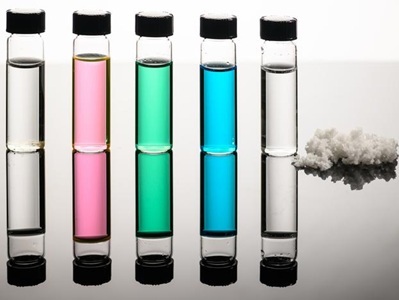
Vials of seawater, Great Salt Lake water, nickel sulfate, copper chloride wastewater, and desalinated water, along with recovered salts show how a new approach developed by URochester researchers turns natural and industrial waters into fresh water and reusable minerals. Credit: University of Rochester photo/J. Adam Fenster
Researchers at the University of Rochester’s Institute of Optics have developed a new solar-thermal desalination process to produce fresh water in an energy-efficient way that does not leave behind brine and requires no chemical additives to pre-treat the water.
In previous solar-thermal desalination techniques, “gumming up” has been a problem. Many components in seawater, such as magnesium- and calcium-based materials, crystallize in a crusty and non-porous fashion on the solar panel’s surface, causing it to clog so eventually water can no longer seep through.
To keep their solar panel surface from gumming up in a similar way, the New York research team precisely etched the black metal’s grooves so various salts and minerals in ocean water would simply slough off.
In their study, published in Light: Science & Applications, the team tested their technique using samples of water from the Pacific, Atlantic and Indian Oceans. They were able to make the surface self-cleaning so that it extracted freshwater and directed the remaining salts to the passive region where they could be later collected without reducing the panel’s efficiency.
One of the method’s distinct advantages is that instead of leaving behind brine that must be disposed of or processed, it extracts nearly 100 percent of the salts in solid form. This could not only produce an abundant supply of table salt, but it could also be used to extract more precious minerals, including lithium.
In a related paper in the Journal of Materials Chemistry A, the team showed how they can use the same superwicking solar panels to separate lithium from the rest of other salts in desalination. Embedding nanoparticles made of hydrogen titanate in the tiny grooves of the black metal surface isolates the lithium from other salts and minerals. Using water samples from Great Salt Lake, the researchers were able to extract about 50 percent of the lithium from the salts left behind by the desalination process.
Now that the superwicking desalination technology has been demonstrated in proofs of concept on small-scale devices, the technology needs to take the next step toward scalability.
Data from University of Rochester