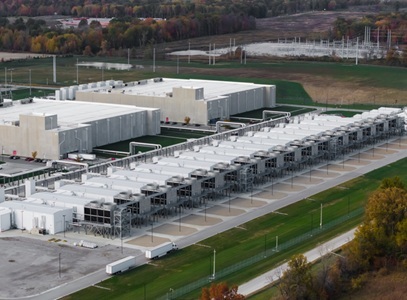
Data center at the suburbs of Columbus city, New Albany, Ohio.
By 2030, the global data centers powering artificial intelligence are projected to consume 945 terawatt-hours of electricity. This is nearly triple the combined annual electricity use of Pakistan, Bangladesh, and Nigeria—countries collectively home to more than 650 million people. Their associated water footprint will equal the basic annual domestic water needs of all 1.3 billion people in Sub-Saharan Africa, and their land footprint will exceed 14,500 square kilometers, roughly twice the Jakarta metropolitan area, home to more than 32 million people.
These stark findings are detailed in the new report, Environmental Cost of AI's Energy Use: Carbon, Water and Land Footprints, by the United Nations University Institute for Water, Environment and Health (UNU-INWEH). Researchers have previously warned about the greenhouse gas emissions of data centers before; but, the UN scientists now argue that the environmental costs of AI and data centers cannot be understood through carbon emissions alone. In their report, they quantify the carbon, water and land footprints of AI's electricity use across the globe and highlight the big differences between these footprints in the world’s 20 largest data center hubs.
Public discussion has largely focused on the energy required to train massive models. Training GPT-3 was estimated to require 1.3 gigawatt-hours (GWh) of electricity, while estimates suggest GPT-4 consumed between 50 and 70 GWh. However, the report reveals this framing is outdated. Once a model is deployed, inference—the continuous running of models to answer everyday user prompts—becomes the dominant cost, accounting for 80 to 90 per cent of total AI energy use. ChatGPT alone is estimated to process around 2.5 billion prompts per day, translating to roughly 383 GWh of electricity per year for a single product. Offsetting associated carbon emissions would require 2.6 million tree seedlings grown for 10 years, enough trees to cover a land area the size of Manhattan. The water footprint is equivalent to the minimum annual domestic water needs of roughly 500,000 people in Sub-Saharan Africa, and the land footprint is equal to over 800 football fields.
“This report is not a case against artificial intelligence, a technological transformation that is improving the lives of billions of people around the world,” said Kaveh Madani, Director of UNU-INWEH who led the investigation team. “It is a call for using it responsibly and addressing its unintended impacts proactively to make it sustainable and equitable. We have a narrow window to ensure that the backbone of the technological revolution of our era develops within planetary limits, and that the communities who provide the critical minerals for advancing AI and the ones that host its infrastructure and e-waste are also among those who benefit from it.”
The report calls for a responsible AI ecosystem built on six principles: transparency; efficiency by design; equity and environmental justice; lifecycle responsibility; global cooperation; and sustainable use. Practical recommendations are directed at each major group of stakeholders:
- Governments should integrate AI infrastructure into energy planning, water governance, and land-use permitting, and require standardized environmental footprint reporting.
- Industry and AI developers should treat model selection, default outputs, and routing decisions as footprint determinants, and improve efficiency by design.
- Users and deploying organizations should adopt fit-for-purpose use — selecting the lightest model and lowest-energy format that meets the task.
- Data center operators and utilities should treat siting and energy procurement as environmental footprint decisions and apply cumulative impact assessment.
- Investors should treat electricity, carbon, water, and land footprints as material risks in AI infrastructure portfolios.
- Communities and civil society should be involved early in data center siting decisions, with enforceable transparency and grievance mechanisms.
- International institutions should support harmonized measurement standards, reduce incentives for cross-border burden shifting, and build compute capacity in excluded regions.
Data from United Nations University