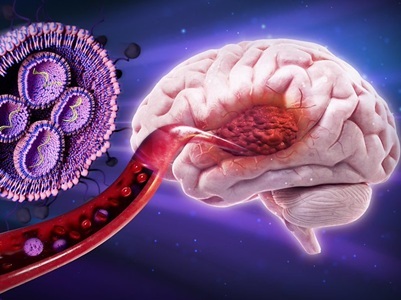
This graphic illustration by Parinaz Ghanbari depicts sugar-coated, mRNA-carrying lipid nanoparticles crossing the blood-brain barrier to treat glioblastoma, the most aggressive form of brain cancer. Credit: OSU
Researchers at Oregon State University have potentially found a new way to treat glioblastoma, the most aggressive form of brain cancer that has a two-year survival rate of less than 30%.
The study addresses two of the most persistent obstacles to current effective glioblastoma treatment: delivering therapeutic agents through the blood-brain barrier and getting those agents to preferentially target tumors.
In research published in the Journal of Controlled Release, the scientists demonstrated their novel treatment technique in a mouse model. They loaded lipid nanoparticles with genetic material that promotes tumor suppression, then coated the nanoparticles with a type of sugar. The result was a 50% median increase in glioblastoma survival time.
The sugar they used was mannose, a close relative of glucose, the body’s primary source of energy. The brain’s endothelial cells are lined with a transporter, GLUT1, tasked with shuttling glucose into the central nervous system. However, the transporter recognizes mannose as well, and that’s what gets the nanoparticles through the blood-brain barrier.
Inside the nanoparticles is messenger RNA that enables the production of PTEN, a tumor-thwarting protein that’s frequently lost in glioblastoma. To prevent the cargo from being disrupted, the scientists added a cationic cholesterol derivative that safeguards the mRNA encapsulation.
“Glioblastoma is metabolically reprogrammed and expresses GLUT1 at three times the levels of normal brain tissue, so the particles preferentially accumulate in tumor tissue after crossing the blood-brain barrier,” said lead author Olena Taratula. “And restoring PTEN expression in tumor cells reinstates growth control. Across repeated dosing, tumor shrinkage occurred without any measurable organ toxicity.”
While showing much early promise, the mannose-cholesterol nanoparticles will still need years of safety and efficacy testing before reaching the market.
Data from Oregon State University