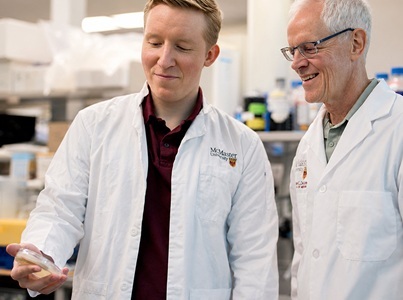
Eric Brown (right) and Rodion Gordzevich (left) discovered a “megacluster” of bacterial genes that enables antibiotic production. Credit: McMaster
Researchers at McMaster University have found an unusual stretch of DNA that encodes four distinct families of natural product antibiotics, including one compound entirely new to science and another never before recognized as an antibiotic.
The “megacluster” of genes found in Streptomyces bacteria simultaneously produce four distinct antibiotics that all work in concert to target a single bacterial vulnerability: biotin, an essential nutrient required by most to survive.
Biotin, also known as vitamin B7, is an essential nutrient that bacteria require for growth and cell division. By disrupting biotin production, uptake and use from multiple angles at once, the coordinated assault leaves competing bacteria with few options for survival.
During their study, published in Nature, the researchers found that the four antibiotic-producing gene clusters are flanked by streptavidin genes, which allow the bacteria to manufacture proteins that bind up available biotin. The result is a two-pronged strategy: the streptavidin proteins sequester free biotin in the environment, while the four antibiotics simultaneously block competing bacteria from producing, acquiring or utilizing any biotin of their own.
The team tested the newly characterized compounds in animal models of infection and found that two of them were highly effective against multidrug-resistant E. coli, offering an early but promising signal that the strategy could one day translate into a new class of treatments for drug-resistant infections.
That the four antibiotic families target the same vulnerability is incredible on its own, but Eric Brown, professor of biochemistry and biomedical sciences at McMaster and principal investigator on the study, said what makes the discovery unprecedented is that all four gene clusters are co-located in the genome.
“It's really sinister,” he said. “Picture one of these molecules taking out the power, another taking out communications infrastructure, another cutting off water systems, and another blocking critical roadways. It's an all-out, strategic, and coordinated attack on rival bacteria.”
Importantly, the study also found that the anti-biotin antibiotic megacluster is widespread across different species of Streptomyces, suggesting that the strategy evolved long ago and has been conserved over millions of years.
“Our analysis showed that this megacluster is even more widespread across Streptomyces genomes than the genes responsible for making streptomycin—one of the classic antibiotics discovered from these bacteria back in the 1940s,” said Rodion Gordzevich, a postdoctoral fellow in Brown’s lab.
Brown said a coordinated multi-antibiotic strategy like this one could theoretically make it harder for resistance to develop, since bacteria would need to evolve several distinct resistance mechanisms simultaneously to survive it.
His lab is now preparing a review that catalogs dozens of known natural product antibiotics that may similarly interfere with nutrient metabolism—a vast and largely untapped reservoir of drug candidates that have been “hiding in plain sight.”
“For decades, drug discovery researchers have been screening for antibiotics under conditions that may actively mask this kind of activity,” said Brown. “What this work tells us is that there is an entire world of nutrient-targeting molecules just waiting to be discovered.”