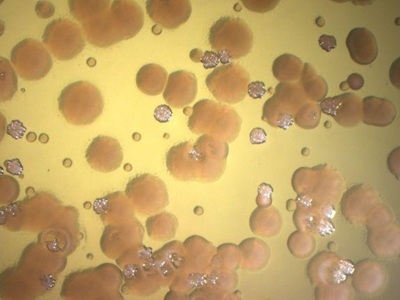
Pseudomonas aeruginosa bacterial colonies from a person with cystic fibrosis growing on agar plates. Credit: Singh Lab via UW Medicine
Bacteria can acquire extreme antibiotic resistance almost instantly—not through the slow buildup of mutations, but by picking up resistance genes handed to them by unrelated bacteria that briefly pass through the lungs during an infection, according to new research.
Sardar Karash, a research assistant professor of microbiology at the University of Washington School of Medicine and the study's lead author, and colleagues made the discovery while investigating cystic fibrosis patients whose infections suddenly stopped responding to a powerful antibiotic. In some cases, resistance jumped more than 10,000-fold almost immediately after treatment began—far too fast to be explained by the gradual genetic mutations that typically drive resistance.
For the study, published in Nature Microbiology, researchers sequenced hundreds of bacteria isolated from patient samples but found no mutations that could explain the sudden shift. Switching to a technique that reads long, continuous strands of DNA revealed the real culprit: the lung pathogens had picked up circular pieces of DNA called plasmids carrying new resistance genes. When the team inserted those genes into drug-sensitive bacteria in the lab, resistance spiked immediately.
Tracing the plasmids' origin, the researchers found that environmental bacteria—species not normally associated with disease—had briefly appeared in patients' lungs just before resistance developed, then transferred the resistance-carrying plasmids directly to the bacteria already causing infection.
“We see environmental bacteria in patient samples from time to time,” said Pradeep Singh, professor of microbiology and medicine at the University of Washington and the study's senior author. “But we thought they were pretty harmless as they aren't very virulent and only appear transiently."
The findings suggest otherwise: even a fleeting visit from outside bacteria can rewire an infection's drug resistance in a single step. Beyond antibiotic resistance, the researchers note that genes passed this way could also help pathogens grab extra nutrients, evade the immune system or break down the barriers that normally contain an infection.
"If environmental bacteria can ferry resistance genes inside human organs, we have to worry about what other genes might be transferred," Karash said.
The researchers are now exploring strategies such as environmental monitoring and containment, along with new methods to block gene transfer between bacteria, as ways to blunt this previously unrecognized route to drug resistance.
Data from University of Washington School of Medicine