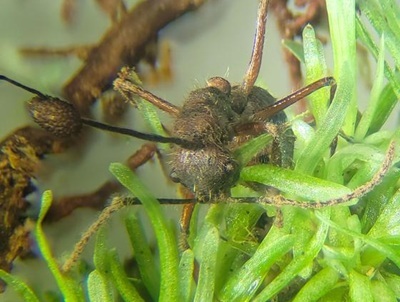
Camponotus nidulans ants infected by O. camponoti-nidulantis found among bryophytes at the Adolpho Ducke Forest Reserve. Specimen “TAJ63” found on Octoblepharum moss. Credit: Tales Alves-Júnior et al., 2026.
A fungus famous for turning ants into mind-controlled zombies also spends part of its life hiding quietly inside Amazonian mosses, according to new research from Brazil's National Institute for Amazonian Research (INPA).
The parasitic fungus, from the genus Ophiocordyceps, is well known for infecting ants and other insects, hijacking their behavior, and forcing them to climb vegetation and clamp their jaws onto a leaf or stem in a “death grip” before dying and releasing spores.
In the study, published in IMA Fungus, researchers used metabarcoding—a technique that reads the DNA of every fungus present in an environmental sample at once—to analyze mosses collected at the Adolpho Ducke Forest Reserve near Manaus.
The analysis turned up the same fungal DNA not just in infected, manipulated ants, but consistently in the surrounding moss itself, including in plants more than 10 meters from any infected insect. This suggests the fungus has a second, previously unnoticed life stage: living quietly inside plant tissue as an endophyte, separate from its insect-manipulating phase.
A similar dual lifestyle was documented in 2020 in a related fungus, “Himalayan gold,”
found living inside alpine plants in China. What makes the Amazonian case notable is that the manipulated ants specifically and consistently bite the same moss species that harbor the fungus's hidden endophytic stage—hinting that the plant itself may play a role in shaping the ant's bizarre behavior, not just the fungus alone.
"We have always thought of this fungus as a parasite exclusive to insects, especially the ones it manipulates," said Tales Alves Jr., biologist and lead author of the study. “What our data suggest is that the story is much larger: the same fungus appears to be ubiquitous in the surrounding moss communities. Our results illustrate a far closer link between the lifecycles of the plants and fungi involved in the behavioral manipulation of Amazonian ants."
The team surmised that the fungus's famous mind control over ants may not be a simple two-way relationship after all, but a three-way exchange between fungus, insect and plant.
Data from Pensoft Publishers