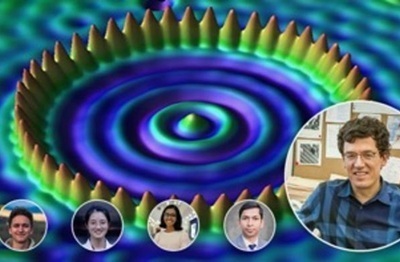
The quantum corral, 48 iron atoms placed one at a time on a copper surface and imaged by scanning tunneling microscopy, built by Michael Crommie with Christopher Lutz and Donald Eigler at IBM Almaden in 1993. Crommie is at right. Along the bottom, the four researchers who presented his papers back to him: Jack Diab, Haiyue Huang, Aswini Ramankutty and Mamun Sarker. Credit: Michael Crommie and the authors
When you read a journal article, it tells a neat, specific research story from beginning to end. The part it doesn’t tell is the “in between”—the moment where the materials were all wrong, how the experiment failed four times before it succeeded, the hallway conversation that completely redirected the endpoint, the tacit knowledge gained that is not recorded in any article subhead.
Two physicists at the University of Pittsburgh have solved that problem by pioneering an incredibly unique format called the “inverseminar,” or inverse seminar. In this format, a senior scientist is invited to participate without asking them to prepare. The scientist listens as their work is presented back to them by a junior scientist.
It sounds wrong until you have sat through one. The researchers say the key is for everyone involved to agree to be uncomfortable before anyone can find out that it works.
Leaping over established barriers
The unique format came out of the pandemic. When seminars moved online in 2020 and then stayed online, a talk that had merely been dull in a lecture hall became something worse. Remote presence did not create the problem, but it removed the last social pressure holding it back.
“Inverting the seminar” fixes the presence problem.
A junior scientist presents a paper to the person who wrote it, which requires a high level of concentration. The audience has to follow closely enough to ask the next question. The invited senior scientist—who has not been told which paper is being discussed—cannot fall back on a rehearsed talk.
What happens next and how the scientist reacts is therefore not a lecture the scientist has given 40+ times. Instead, the paper presentation becomes a trigger for episodic memory, a recollection of the events that preceded or took place during the struggle to produce new knowledge, rather than the organized version represented in the journal article.
“Every paper has a story that the paper itself does not tell,” said Jeremy Levy, distinguished professor of physics at the University of Pittsburgh, who pioneered the idea along with colleague Chandralekha Singh.
Levi said hearing your own research described by someone who had to reconstruct it from the outside turns out to be disarming rather than adversarial, and the reaction is almost always to supply what the presenter could not have known: the false start, the argument, the person whose name is on the paper for reasons the paper does not give.
The researchers developed and tested the format in physics, where the example cited is Michael Crommie of the University of California, Berkeley. In 2010, his group published a result in Science on how graphene behaves under strain, and it started a subfield.
The published account is of course orderly, but in the inverseminar, Crommie revealed the discovery happened “totally by accident.” His group had been studying graphene for unrelated reasons when they saw something nobody could explain. Months of confusion followed, until the theorist Antonio Castro Neto “just happened to be” Crommie’s office and recognized what they were looking at. Castro Neto is a coauthor on the 2010 paper—nothing in it indicates how he became one.
To prove the inverseminars are not just for physics, Levi and team ran seven inverseminars over 27 months across different fields. The study, published in Nature Physics, found the pattern held each time.
“Any field that publishes polished accounts of unpolished processes has the same distance between what its practitioners know and what its literature contains, and the incentives that produce the clean version are the same everywhere,” said the researchers.
Alongside the paper, the team is launching the inverseminars.org site, open to researchers in any discipline. Each session receives its own citable DOI, so a recording becomes something that can be referenced the same way a paper is.