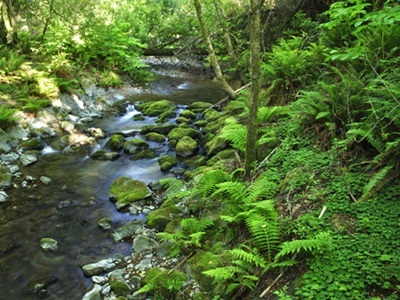
A new study warns groundwater pumped to irrigate cannabis crops in California's Emerald Triangle can cause streams that normally run year-round to dry up entirely by summer.
For the study, published in the Journal of Hydrology, researchers focused on groundwater pumping of headwater streams in two watersheds within California's Emerald Triangle—a globally recognized cannabis-growing region increasingly vulnerable to water shortages.
Using a new modeling approach, the team analyzed 580 water use scenarios to understand how groundwater pumping and environmental conditions interact to shape streamflow in the region's rugged mountain headwaters.
Under realistic agricultural water demands, the researchers found that pumping can cause seasonal streams to stop flowing up to 5 weeks earlier than usual, and in some cases can dry out streams that would typically flow year-round. The effects were most pronounced during dry years and in watersheds with limited capacity to store water underground.
Notably, even in watersheds where cannabis cultivation covered only a small share of the land, pumping still produced measurable impacts on streamflow—effects the researchers say could reduce salmon habitat and diminish flow into larger river systems downstream.
“During heat waves and droughts, demand for irrigation often increases at the same time stream ecosystems are under the greatest stress,” says Jesse Hahm, assistant professor of geography and co-author of the study. “What matters is not only how much water is used, but when and where it is taken. We found that in these upland, mountainous landscapes, pumping water from underground can affect streamflow in ways that may not be immediately obvious.”
The findings help address a significant knowledge gap as communities across western North America lean more heavily on groundwater during hotter, drier summers driven by climate change. Snow has traditionally functioned as a natural reservoir, gradually recharging groundwater through spring and early summer, but that pattern is shifting.
Data from Simon Fraser University