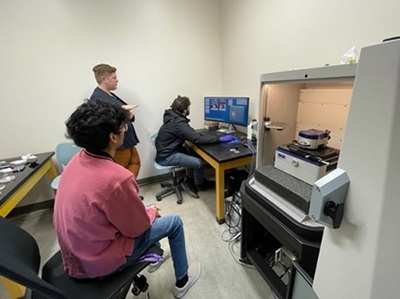
Jonathan Azenon '24 (front left) and Ryan Zurick '24 (back right) use an atomic force microscope alongside Associate Professor of Biochemistry Catherine Volle in February of 2024 during this research process. Credit: Cornell College
Scientists have discovered surprising results in their research on antimicrobial peptides, which are being studied as a method of combating antibiotic resistance. These peptides, part of the innate immune system, could be used to kill bacteria on their own or to create channels for other antibacterial drugs to enter bacteria, complicating the strategy against resistance.
The team found that high concentrations of the antimicrobial peptide Magainin 2 cause E. coli bacteria to become more rigid rather than softer.
For the study, published in AppliedPhys, the team from Cornell College tested how E. coli responded to Magainin 2 at low, medium and high concentrations.
At low concentrations, the peptide behaved as expected, forming pores that made the bacterial cells softer over time. But at high concentrations the kind that would likely be needed in a clinical setting—the cells instead became stiffer and sealed themselves off from larger molecules, which would undercut any attempt to use the peptide alongside other antibacterial drugs.
The researchers say the finding underscores how much remains unknown about translating a promising class of compounds into real treatments.
“[The study] demonstrates just how complicated it is to develop new ways to kill bacteria, even when you have a promising avenue,” said study author Ryan Zurick. "Just because we have a category of peptides that seem to generally be very effective at killing bacteria, doesn't mean that our understanding of them will translate well to clinical settings."
Pinning down the right peptide-to-drug ratio could eventually lead to effective combination therapies for bacterial infections, particularly as antibiotic resistant infections rise. The team is planning to continue and expand upon the research through the rest of the summer.
Data from Cornell College