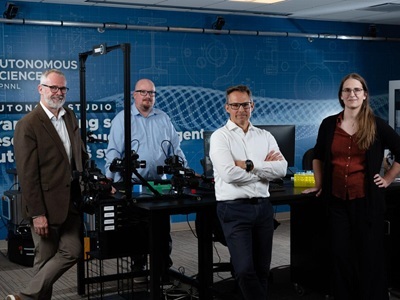
Leaders from Pacific Northwest National Laboratory's Center for Robotics and Autonomy pose in the Autonomy Studio on the PNNL-Richland campus. From left to right: Russ Burtner, Brian Higgins, Bob Runkle, and Lauren Phillips. Credit: Eddie Pablo III | Pacific Northwest National Laboratory
Not long ago, teaching a robot to move a beaker across a lab bench required a software engineer, months of programming and endless trial and error. Today, Bob Runkle can walk into a room at Pacific Northwest National Laboratory (PNNL), type a plain-language instruction, and watch a robotic arm carry out the task on its own.
Runkle directs PNNL's newly launched Center for Robotics and Autonomy, an effort to weave automation and artificial intelligence into nearly every corner of the laboratory's scientific work. The center's goal is nothing short of transformative: within 5 years, autonomy will touch every experiment run at PNNL.
“The science of tomorrow won’t look like the science of today,” said Runkle.
At the core of that effort is a platform called ARCADIA, which is short for Agentic Robotics and Curated AI Data for Intelligent Autonomy. Rather than building separate robotic systems for each research project, PNNL designed ARCADIA as shared infrastructure that any lab across the facility can draw upon. The platform links AI agents, robotics and data systems into a single discovery ecosystem—enabling instruments, researchers and autonomous systems to all pull from the same stream of information.
Malachi Schram, who leads the platform's development, said the idea grew out of watching pockets of AI experimentation pop up independently across the lab.
“There is a lot of AI agentic work that's going on across the lab, and we would like to learn what everybody is doing so everyone benefits from this revolution,” he said.
Central to ARCADIA is a multi-agent tool called SciLink, which helps automate stages of the scientific process, from generating hypotheses and designing experiments to running simulations and analyzing results.
Speed and reproducibility
Speed is only half the equation, though. Runkle says it is critical that the push toward automation does not come at the expense of scientific reliability.
Thus, the center is building in checkpoints that require human scientists to sign off on an AI agent's actions or conclusions before an experiment moves forward. Runkle is careful to note that autonomy is meant to support human judgment, not replace it.
“We need people to imagine the science we should be doing and to define the interesting questions,” he said. “That's a judgment call. That's subjective and it should stay that way."
Through ARCADIA, its partner network, and its emphasis on verification and reliability, the CRA represents an ambitious approach to autonomy, but one that is tied to the trustworthiness of the systems producing it.
“We are in a race to maintain a competitive advantage in scientific discovery in the service of our national interests,” said Runkle. “We can’t afford not to move as fast as we can to put the best tools in the hands of our scientists.”