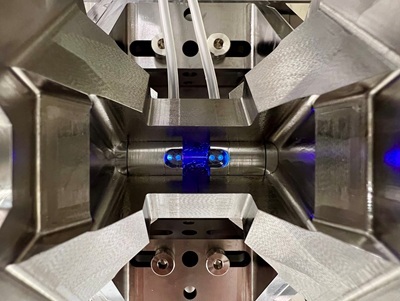
The experiment: helium atoms are irradiated with a laser. Credit: © TU Wien
By exploiting the correlated behavior of two electrons in a helium atom rather than just one, physicists have devised a way to generate coherent X-rays at energies higher than the long-established limit.
For the study, published in Nature Photonics, researchers from TU Wien and the University of California San Diego built on the mechanism behind ultra-short X-ray pulses, work that earned the 2023 Nobel Prize in Physics. In that process, a laser tears an electron away from an atom, accelerates it and slams it back into the atom—releasing energy as light. The standard theory sets a hard "cutoff" on how high that energy can go, based on the properties of the laser itself.
The team found a way around that limit by using helium atoms, which have two electrons that can be released one after another and remain quantum mechanically correlated. Using intense UV laser pulses, the researchers arranged for both electrons to return to the atom simultaneously, releasing their combined energy at once and producing a single, higher-frequency X-ray photon. In the resulting spectrum, a second, weaker plateau of X-ray energies appeared well above the range predicted by conventional theory.
The effect showed up only in helium, an atom with unusually strong electron correlations—argon and neon, whose valence electrons don't share that correlation, produced no such plateau.
The researchers say the new X-ray signal could serve as a sensitive probe of electron-electron correlations on attosecond timescales, with potential applications extending to molecules and strongly correlated solid materials, insights that could ultimately inform quantum computing and the design of advanced nanomaterials.
Data from TU Wien