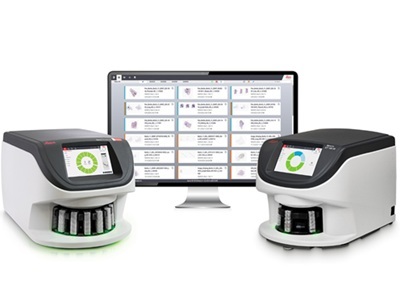
Leica Biosystems has announced multiple U.S. Food and Drug Administration (FDA) 510(k) clearances that strengthen its connected clinical digital pathology portfolio, including the industry’s first standalone, AI-assisted quality control software. These advancements are designed to help pathology laboratories deliver high-quality digital images more consistently and efficiently to support timely, confident diagnoses for patients at a critical moment when case volumes, staffing pressures, and diagnostic complexity continue to increase.
These FDA 510(k)-cleared innovations reinforce Leica Biosystems’ commitment to enabling better care for patients by helping laboratories move beyond digitization toward more connected, standardized and scalable clinical workflows.
The expanded U.S. clinical portfolio introduces Aperio iQC DX software, adds the Aperio GT 180 DX scanner, and enhances capabilities for the Aperio GT 450 DX scanner—providing laboratories with greater flexibility to scale digital pathology while maintaining speed and quality.
As the industry’s first FDA 510(k)-cleared software product for AI-assisted digital pathology quality control in a clinical setting, Aperio iQC DX software represents a significant step forward in accelerating time to diagnosis. Whole slide images can be affected by artifacts introduced during tissue preparation, staining, coverslipping or scanning—such as air bubbles, pen marks, clipped tissue, missing tissue, out-of-focus regions and image striping.
By detecting these six common issues automatically while slides remain on the scanner, Aperio iQC DX software enables laboratories to identify and resolve potential quality concerns earlier in the workflow. This helps reduce the need for rescanning or rework, minimize downstream delays, and support more consistent, reproducible image review to help pathologists deliver answers with greater speed and certainty when every moment matters.
In a real-world data study, the AI models detected up to 24% more artifacts missed by histotechnicians and reduced hands-on review time by 69%, helping laboratories reallocate skilled staff to higher-value tasks and keep cases moving efficiently through the diagnostic process.
Leica Biosystems continues to expand its clinical scanning portfolio to meet the needs of laboratories across a range of volumes and workflow requirements. With broad global adoption, the high-throughput Aperio GT 450 DX clinical scanner is proven to deliver the speed, quality, and capacity needed to manage complex caseloads. The 450-slide capacity, industry-leading automation, and small footprint enables rapid conversion of glass slides into digital images for clinical review and confidence in results, supporting the faster movement of cases through the diagnostic pathway. This latest release includes new manual scan capabilities for more complex slides, advanced DICOM capabilities, and z-stacking for the clinical environment.
The Aperio GT 180 DX clinical scanner extends Leica Biosystems’ clinical scanning portfolio to mid-volume laboratories seeking to scale digital pathology in a way that fits their case mix, staffing model, and operational needs. With a smaller 180-slide capacity and the same scan speed and comprehensive feature set as the Aperio GT 450 DX scanner, the Aperio GT 180 DX scanner helps laboratories build connected digital pathology workflows that can support timely review, diagnostic confidence, and better care delivery.
This expanded portfolio helps laboratories move from slide preparation to diagnosis with greater speed, consistency and less variability.