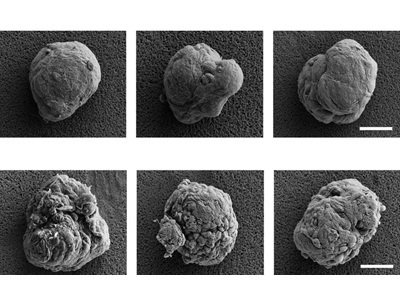
The top row of photos, taken with a scanning electron microscope, shows uncoated cell clusters (islets), with a 50-micrometer, or 0.05 millimeter, scale bar for reference. The bottom row showcases a series of islets covered in a thin film that acts as an “invisibility cloak,” hiding the donor cells from the body’s immune response and potentially offering researchers a novel approach to treating diabetes. Credit: Kyungsene Lee
A thin hydrogel coating that hides therapeutic cells from the immune system kept diabetic mice free of high blood sugar for over 100 days without any immune-suppressing drugs, according to Penn State researchers.
For the study, published in Nature Biomedical Engineering, the Penn State team developed a material called biomimetic zona pellucida, or BZP, designed to mimic the natural protective coating found on human egg cells. They spent eight years refining the process until they could apply a layer just 20 micrometers thick—thinner than a human hair—around insulin-producing cell clusters, called islets, without damaging the cells or interfering with their function.
Cell therapy already treats several diseases by introducing prepared donor cells into a patient's body, and the FDA approved the first such treatment for diabetes in 2023. But current approaches require patients to take immunosuppressant drugs continuously, raising the risk of infection and other serious side effects, including cancer. The BZP coating is designed to solve that problem by physically shielding the islets from immune cells while remaining porous enough to let insulin pass through into the bloodstream.
To test the approach, the researchers coated islets in BZP and transplanted them into diabetic mice, then tracked blood sugar levels for 100 days. Treated mice saw blood sugar return to healthy levels within a week and stayed diabetes-free for the full 100 days without immunosuppressants—far outlasting uncoated cell therapies, which typically lose effectiveness within about a week without systemic immune suppression.
Earlier attempts at cell encapsulation had never managed to replicate the natural coating's ultrathin structure closely enough to make it work.
“Our body is amazing — by mimicking the natural, ultrathin coating formed by proteins on egg cells, we can fortify and cloak cells for therapeutic transplantation,” said Kyungsene Lee, first author on the paper and a postdoc at Harvard Medical School who earned a doctorate in biomedical engineering at Penn State.
Going forward, the team plans to further study the BZP approach to better understand the specific duration of resistance each islet transplant could offer. In the long-term, this approach could offer a promising commercial cell therapy platform to treat not just diabetes, but a host of diseases and conditions across the body.
“This technique could be useful in immunotherapy, priming cells to resist chronic disease, or in regenerative medicine, stimulating cell growth to regenerate tissues in damaged or lost organs,” said cooresponding author Yong Wang, professor of biomedical engineering. “Simply speaking, BZP could be massively helpful across a broad span of biomedical engineering applications.”
Data from Penn State