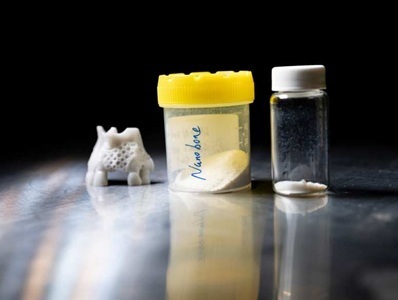
The study is the first to demonstrate a single nanomaterial platform that combines rapid blood clotting, activation of the body’s own latent growth factors, recruitment of bone-forming stem cells and enhanced bone regeneration. Credit: Stef Zingsheim/University of Sydney
Researchers at the University of Sydney have developed a biodegradable "nanobone" material that harnesses the body's own healing processes to regrow bone, offering a potential future alternative to bone graft procedures that have changed little in more than 50 years.
The research was designed with children born with cleft lip and palate in mind, a birth defect affecting around 1 in 700 children. Repairing the jawbone gap is one of the most complex stages of treatment, and many patients must wait until they're 10 to 12 years old for the invasive surgery. In the meantime, the condition can affect a child's breathing, eating and speech, along with their confidence and social development.
For the study, published in ACS Nano, researchers tested a calcium-aluminosilicate nanomaterial in a preclinical bone model. After 8 weeks, the material generated 80 percent more new bone than a control material. The new material also activated a key bone-repair growth factor at 10x the level achieved using conventional methods.
Rather than delivering manufactured growth factors, the material activates a naturally occurring growth factor already present in the body called latent Transforming Growth Factor β1, which draws bone-forming stem cells to the injury site and encourages them to develop into bone-producing cells. Over time, that process replaces the material with the body's own tissue. The material also promoted blood clotting within about 30 seconds, helping stabilize the injury site during the earliest stages of healing.
“Our body already contains many of the signals needed for tissue repair,” said Chun Xu, associate professor and Sydney Horizon Fellow in the Faculty of Medicine and Health. “We've developed a material that can help activate those signals at the right place and time. Instead of supplying external growth factors, we're encouraging the body to use its own healing potential.”
The study is the first to demonstrate a single nanomaterial platform that combines rapid blood clotting, activation of the body’s own latent growth factors, recruitment of bone-forming stem cells and enhanced bone regeneration.
Xu’s team is now exploring how the material could be built into personalized 3D-printed scaffolds matched to an individual patient's specific bone defect.
Data from University of Sydney