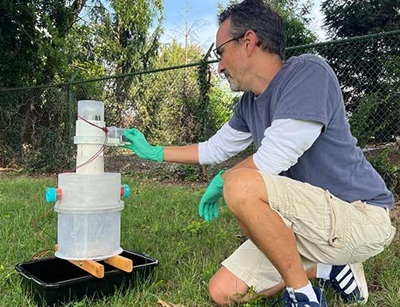
Dana Price of the Center for Vector Biology sets a mosquito-waste collection trap in the field as researchers work to adapt the approach for real-world surveillance. Credit: Dana Price via Rutgers
Public health researchers have long tested wastewater for genetic traces of diseases like COVID-19 and polio. Rutgers entomologist Dana Price wondered whether the same idea could work for mosquitoes—a question that led him to build what he calls “a mosquito toilet” that uncovered much more than expected, including several viruses that may be new to science.
The “mosquito toilet” is a simple device: a 3D-printed funnel coated with a superhydrophobic material that causes mosquito waste droplets to bead up and slide into a collection tube.
Old and new
Traditional mosquito surveillance requires collecting large numbers of insects, sorting them by species, grinding them into pools and testing for specific pathogens—a labor-intensive process that can delay information during an outbreak and only detects what researchers already know to look for.
Since mosquito waste contains far less insect tissue and DNA than a crushed mosquito, the researchers hypothesized that viral genetic material trapped in the waste might be easier to isolate and identify.
For their study, published in Microbiology Spectrum, Price and team collected two groups of 50 wild Culex mosquitoes from a yard in New Brunswick, New Jersey, in 2021 and 2022, placing each group in a screened container over the new device and feeding them a sugar solution.
The resulting waste droplets were run through shotgun metagenomic sequencing, a technique that captures all genetic material in a sample rather than targeting a single pathogen. Software then assembled the millions of resulting fragments and compared them against known sequences in scientific databases.
The 2022 sample yielded a complete, high-quality genome of West Nile virus, identified as the NY07 genetic variant already known in the region. Price says this level of detail could eventually help scientists track how viral variants emerge and spread.
Price and team also found evidence of a Hedwig-like virus, which hadn’t previously been reported in the Americas. Hedwig virus was first identified in Europe in snowy owl tissue, prompting scientists to name it after Harry Potter’s famous white owl.
Scientists don't yet know whether Hedwig-like viruses make birds sick or interact with West Nile virus, and Price cautioned the finding doesn't establish the virus as a threat—only that it has been circulating undetected. He is now working with New Jersey's Division of Fish and Wildlife to screen tissue from deceased birds for the virus.
The mosquito waste also contained several sequences different enough from known viruses that the team classified them as potentially new to science, including a partiti-like virus, a picorna-like virus and a virus associated with parasites. Most appear to infect mosquitoes, other insects or microorganisms living inside mosquitoes and are not known to cause human disease. Some insect-specific viruses may even interfere with mosquitoes’ ability to carry West Nile, dengue or Zika viruses.
“The more data we generate, the more we start to wonder if everything is everywhere,” said Price. “Although we don't yet know how much of everything is everywhere, it may be a lot more than we realize.”
Early warning system
Researchers cannot conclude from waste alone that a mosquito can transmit a virus. It could be infecting the mosquito or another organism inside it or simply passing through. For now, the technique can answer a broader question: is a pathogen circulating in this environment?
The team is working toward a field-ready trap that would collect mosquitoes and their waste. Price eventually envisions a system that could prepare samples, sequence genetic material, analyze the results remotely and alert scientists to a possible threat in real-time.
“The pie-in-the-sky idea is a device that we place in a forest somewhere, and it’s constantly just beaming back data to us,” he said.
Such a system could be especially valuable in remote or resource-limited areas, revealing known pathogens before they cause widespread illness and exposing the ones no one yet knows to look for.