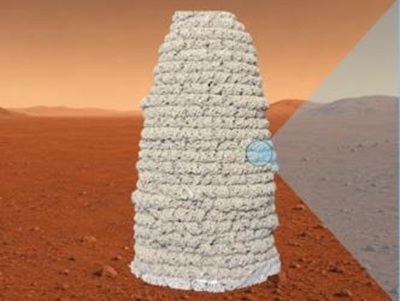
Living building material can be 3D printed under simulated Martian conditions at –30°C and 0.01 atm. Credit: Cell Press
Researchers have developed a living building material made from Martian rock, gelatin and engineered yeast that could one day be 3D printed into houses on Mars. Once dried and hardened, the material is as strong as low-grade concrete and can be broken down, recycled and brewed again for new construction.
For the study, published in Chem Circularity, researchers at The Hong Kong University of Science and Technology engineered yeast coated with highly adhesive proteins—including those mussels use to cling to rocks—and combined it with gelatin to act as a binding glue for simulated Martian sand.
The gelatin knits the ingredients together and gives the yeast cells a place to grow, while the sand provides mass and structure. Once extruded through a printer nozzle under simulated Martian conditions—extreme cold and near-vacuum pressure—the material freeze-dried almost instantly. Water turned directly from ice into vapor and left behind a network of microscopic pores, resulting in a light, foam-like structure.
“My inspiration came from freeze-dried fruits that become harder,” said civil engineer and senior author Jishen Qiu of The Hong Kong University of Science and Technology. “This is actually strong enough to build a one- or two-story building on Earth whose gravity is three times that of Mars. So, you can probably easily build a multistory building on Mars with the material.”
For now, the printed structures are about wine-cork-sized small domes, standing at 45 mm tall and 30 mm wide. But the material itself is strong—with a compressive strength of 10 to 12 megapascals, comparable to low-grade concrete.
Because many other proposals for extraterrestrial construction rely on melting rock or lunar dust into bricks, which demands substantial energy, this biology-based approach could save power while also enabling a circular building economy. Settlers could recover living yeast from dismantled structures and regrow it in bioreactors for new construction.
“As long as there's one yeast that’s still alive, you can grow them again,” said Qiu.
Data from Cell Press