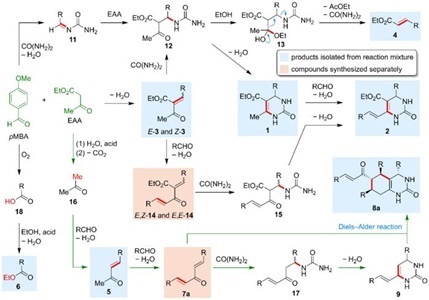
The route to 8a, indicated with green arrows, was proposed with the help of mechanistic-level chemical AI. Credit: Institute for Basic Science
Researchers using a robotic chemistry platform have discovered a previously unknown reaction pathway hidden inside the Biginelli reaction, a well-known chemical process first reported in 1891, revealing complex new molecules with unusual self-assembling properties.
In the study, published in Nature Synthesis, researchers at the Institute for Basic Science, used an automated robotic system to test 960 different combinations of reaction conditions for the Biginelli reaction, rather than searching for the best conditions to produce a single known product. This systematic mapping of the reaction's full range of possible outcomes uncovered a previously unrecognized branch of the reaction that produces complex, ring-shaped molecules unlike the compounds the reaction is normally known to generate.
Mechanistic analysis aided by chemical artificial intelligence showed the unexpected pathway involves seven molecules of starting material combining to form a single complex product, a type of transformation rarely seen in organic chemistry. The team then redesigned the synthesis process to deliberately produce a family of related molecules, some approaching the structural complexity of natural products.
The newly discovered molecules displayed unusual behavior beyond their structure alone. Some spontaneously assembled into larger structures depending on their concentration and temperature, while others selectively bound metal ions such as barium and zinc.
One compound showed an especially rare form of “chiral self-sorting,” in which the molecule's preference for pairing with mirror-image versions of itself shifted depending on whether zinc or barium ions were present. Researchers say this metal-programmable sorting behavior is uncommon and could prove useful for applications like enantioselective sensing and responsive materials.
The researchers say this approach could transform chemical automation from a tool for speeding up experiments into a platform for discovering entirely new chemistry. Even reactions that have been studied for more than a century may still contain hidden pathways that become visible only when their conditions are explored systematically.
Data from Institute for Basic Science