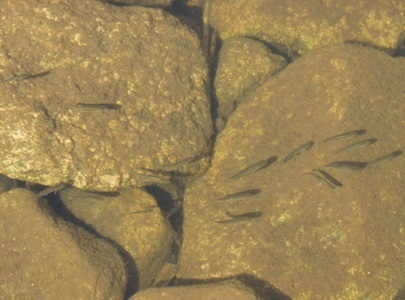
A new study led by researchers from McMaster University found that a synthetic hormone commonly found in wastewater altered the behavior of wild fathead minnows. Credit: Karen Kidd
Researchers have discovered that a common wastewater pollutant turns male fathead minnows into worse fathers and fiercer rivals, revealing ecological impacts that laboratory studies missed. The pollutant, called ethinylestradiol (EE2), is a synthetic estrogen used in oral contraceptives and other hormone therapies.
For the study, published in Current Biology, researchers at McMaster University monitored male fathead minnows before, during and after a three-year period in which trace amounts of EE2 were added to an experimental lake, comparing the exposed fish to populations in nearby unexposed lakes.
Laboratory studies had previously suggested EE2 exposure would reduce aggression in male fish, but the whole-lake experiment found the opposite. Male fathead minnows normally establish territories, court females and guard eggs in their nests, but during the exposure period, more fish gathered around active nests, intensifying competition and forcing nesting males to spend more time defending their territories and eggs.
Researchers say that added rivalry, combined with reduced parental care and fewer eggs surviving in nests, likely contributed to the population collapse they observed.
“The hormone didn't just affect individual fish. It changed the social conditions in the lake,” said lead author Erin McCallum, associate professor at the Swedish University of Agricultural Sciences. “Those changes had ripple effects on reproduction across the population.”
The findings suggest scientists may be underestimating the ecological risks posed by hormone pollution and other contaminants.
“In the lab, the environment and animal interactions are controlled and simplified; in these whole-ecosystem experiments we capture the complex and often unpredictable responses happening in response to chemical pollution,” said study author Karen Kidd, a professor in the Department of Biology. “That’s why large-scale experiments like this are so valuable. They allow us to see consequences that would otherwise remain hidden.”
The researchers hope the results will help strengthen environmental risk assessments and support efforts to protect freshwater ecosystems from hormone pollution going forward.
Data by McMaster University