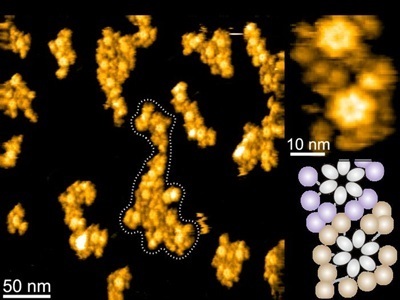
High-speed AFM image of CaMKIIα holoenzymes in the basal state, assembled into a chain-like cluster (dotted outline). The magnified view (top right) and schematic (bottom right; purple and brown spheres denote the kinase domains of two adjacent holoenzymes) show that neighboring holoenzymes are linked through their kinase domains. Credit: Adapted from Suzuki, T. et al., Science Advances (2026).
Researchers have directly observed how CaMKIIα, a protein essential to learning and memory, organizes itself into chain-like structures under crowded cellular conditions—and how a mutation linked to neurodevelopmental disorders disrupts that process.
For the study, published in Science Advances, researchers used high-speed atomic force microscopy to watch how CaMKIIα molecules move and interact. The protein normally forms ring-shaped complexes called holoenzymes, and gathers in especially large amounts at synapses. But, researchers had not previously been able to see clearly how individual molecules come together there.
At low concentrations, where the holoenzymes could move freely, more than 95 percent of the protein stayed as individual particles and no stable clusters formed. But when researchers recreated the high density and restricted movement typical of a synapse's signaling region, the holoenzymes began contacting one another and assembling into stable chains, linked through the regions responsible for their catalytic activity.
When the researchers activated the protein by simulating a rise in calcium—the trigger that switches on CaMKIIα during memory formation—its structure opened up and the resulting chains grew larger, with neighboring molecules moving about four nanometers farther apart. A chemical tag the protein can add to itself, called autophosphorylation, helped keep these larger chains stable.
The researchers also studied a mutated version of the protein called P212L, linked to intellectual disability and other neurodevelopmental disorders. They found it formed much larger clusters than normal CaMKIIα, even while inactive, evidence the mutation makes it harder for the protein to stay in its folded, switched-off shape.
“Our observations connect the structural changes of individual CaMKIIα holoenzymes with their collective organization at a larger scale,” said lead researcher Mikihiro Shibata. “The results suggest that activation does more than switch on kinase activity: it also changes how CaMKIIα molecules assemble with one another.”
The findings were made in a purified experimental system on a flat surface rather than inside living neurons, so the researchers next plan to test whether similar chain-like clusters form in intact synapses and how changes in cluster size affect neuronal function. The team says the work could eventually inform new models of how memories form and deepen understanding of neurodevelopmental disorders tied to mutations in the gene that produces CaMKIIα.
Data from Kanazawa University