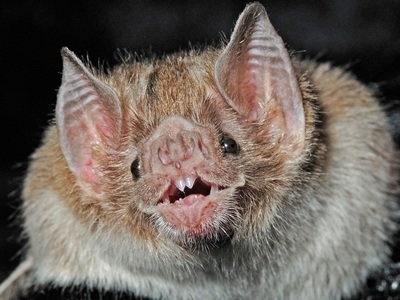
The common vampire bat (Desmodus rotundus), which survives by eating blood, has a distribution from Mexico to Argentina. Credit: Brock and Sherri Fenton
The largest study of bat genomics ever conducted has overturned decades of scientific thinking, showing that bats originated in Europe roughly 65 million years ago rather than in Africa, Asia or North America as long believed.
The research could help define genes implicated in human health and longevity, including aging, immunity and disease resistance.
For the study, published in Nature, a team of researchers from 64 countries known as the Bat1K consortium, generated and analyzed genome data from 103 bat species alongside traits from 44 fossil species.
“The approach we used to model the evolution of fossil and living bat species together can do what other methods cannot: identify the oldest group of fossil bats while taking the genomic data into account and uncover when and where bats originated,” said co-corresponding author Liliana Dávalos, professor at Stony Brook University.
The models of evolution account for changes in both morphology and genomes of the bats, as well as how continents change over time.
This enabled the team to overturn previous hypotheses proposing Asian, African or North American bat origins in favor of a European one. The earliest descendants dispersed to Africa, and then they established a Europe-Africa hub from which bats then expanded into Asia, the Americas and Australia.
The fossil evidence also provided important clues about another long-standing mystery: when bats first evolved echolocation. Key to this work was the placement of the fossil bat Vielasia within the oldest branch of the bat family tree. This bat had features that point to the ability to echolocate, suggesting that echolocation predates the diversification of modern bats. The finding suggests that two of the defining characteristics of bat biology—powered flight and echolocation—evolved near the origin of the group itself.
The research into powered flight and other evolutionary characteristics of bats gives scientists not only a genomic map for how the bat lineage evolved powered flight and advanced biosonar but also lays the foundation for understanding other extraordinary bat characteristics, including their resistance to disease and long lives.
Data from Stony Brook University