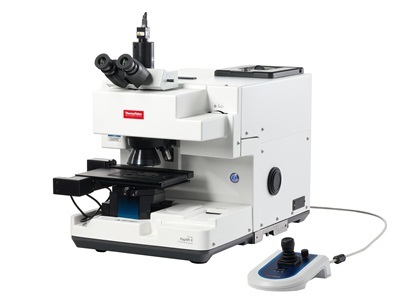
Thermo Fisher Scientific has launched the Thermo Scientific Nicolet RaptIR X FTIR Microscope, the latest advancement in FTIR microscopy designed to make chemical analysis of microscopic samples more accessible, intuitive and efficient for laboratories.
Combining high-definition optical microscopy with Fourier Transform Infrared Spectroscopy (FTIR) microspectroscopy, the RaptIR X microscope helps users pinpoint microscopic features and identify their molecular composition, supporting a wide range of applications from identifying polymers and microplastics and analyzing pharmaceutical formulations, to investigating material failures and characterizing materials in forensic, art conservation and geological research.
Built on 50 years of Nicolet innovation in FTIR spectroscopy, the RaptIR X microscope is designed to simplify FTIR microscopy for both experienced spectroscopists and users new to the application. The microscope is operated through the intuitive Thermo Scientific OMNIC Paradigm Software, which provides guided workflows for sample acquisition and analysis, helping streamline the path from measurement to molecular insight.
With the instrument, researchers can capture up to 10 spectra per second at 5-micron spatial resolution, supporting rapid chemical mapping of large sample areas and helping users move from sample to results more efficiently.
One-micron visible resolution and 5-micron infrared resolution enable users to precisely visualize microscopic features and identify their molecular composition.
A heavy-duty stage accommodates samples up to 40-mm thick and weighing up to 5 kg, supporting laboratories working with large or challenging samples. Automated detector switching and a fixed detector position helps reduce manual intervention and support consistent measurements across different measurement ranges.
The modular RaptIR X microscope can operate as a standalone system or integrate with Nicolet Apex or Nicolet iS50 FTIR spectrometers. Optional capabilities, including micro-ATR, polarized visible and infrared analysis, fluorescence visualization, near-infrared microscopy, grazing angle optics and additional detectors, allow laboratories to configure the platform for their evolving needs.