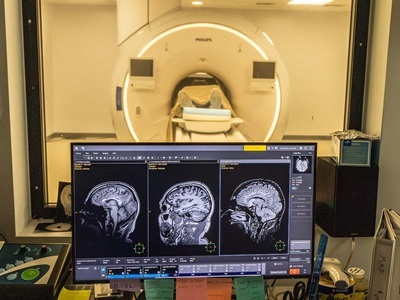
The BU-led DIAGNOSE CTE Research Project brings former football players in for thorough medical and neurological exams; researchers hope to diagnose the brain disease CTE in the living and open the door to new treatments. Photo by Mike Cohea
A research team led by Boston University has, for the first time, discovered a way to accurately detect the presence of CTE neuropathology using only a blood test.
“I think this finding will significantly change the landscape for clinical research in CTE moving forward,” said Michael Alosco, CTE Center codirector of clinical research who led the study and is its corresponding author. “If our finding is validated, having a biomarker that can accurately detect CTE will open the door to diagnosis when people are still living and to an entirely new phase of research, including clinical trials where we can start to focus on treatment.”
In the study, published in the Journal of the American Medical Association, researchers examined a sample of 21 former football players who had their blood drawn in life and donated their brains upon their death. Of the 21 participants, 18 had CTE at autopsy and three did not. Of those with CTE, 16 had high-stage and two had low-stage; five also had Alzheimer’s disease.
The researchers examined participants’ blood for a protein called endogenously cleaved microtubule-binding region tau (eMTBR-tau), a marker of a tangle of misfolded proteins in the brain that also are known to form in Alzheimer’s disease. Researchers observed that blood plasma eMTBR-tau concentrations were significantly higher in participants with high-stage CTE than in those with low-stage or no CTE.
Researchers also evaluated a blood marker known to be specific to Alzheimer’s disease changes, called p-tau217. It was only elevated in those who had Alzheimer’s disease. Alosco says this suggests the combination of eMTBR-tau and p-tau217 might be optimal for detecting CTE during life and differentiating from Alzheimer’s disease.
“I was shocked when I first saw the data as we have tested many biomarkers to this point and none have worked out until now,” said Alosco, a BU Chobanian & Avedisian School of Medicine professor of neurology and vice chair of research. “While a small sample size, this is also the gold standard type of study design to identify a biomarker for a disease. It takes years, even decades, to collect large samples of people who have data collected during life and who also donated their brain. We hope to grow our sample size moving forward.”
Indeed before the blood test can be made available for clinical trials, the findings must be validated in larger autopsy studies.
“That will greatly facilitate our ability to move this finding toward [FDA] approval and bring it to patients,” said Alosco. “But we aren’t there yet.”
Data from Boston University