An HPLC detector is used to analyze the components of the eluted mixture that is collected after being run through an HPLC column. Differences in detector type are based on what is being detected. Detection can be done by measuring absorbance, changes in reflex indices, molecular weight, and fluorescence among others. When selecting a detector, it is important to consider the sample type being analyzed. Some sample types will not work or will have lower sensitivity on particular detectors. Also of consideration is the type of information that is being sought by the analysis and what method will be used when running the column, for example, some detectors will work with the gradient method while others will not.
Find, compare, and request a quote for HPLC detectors across leading suppliers at Labcompare; including access to product citations, related published figures, and first-hand reviews from our scientific community.
|  |  |  |
| Company | Waters | Wyatt Technology | Waters | Wyatt Technology | Waters | Wyatt Technology |
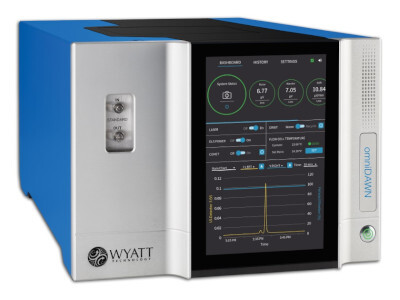
| Item | Optilab™ Refractive Index Detector for HPLC/GPC | microDAWN™ Multi-Angle Light Scattering Instrument for UHP-SEC-MALS | omniDAWN™ Multi-angle Light Scattering (MALS) Instrument |
| Citations | | | |
| Catalog Number | Optilab | microDAWN | omniDAWN |
| Price | | | |
| Type | Refractive Index Detector | MALS and optional DLS | Multi-Angle Light Scattering (MALS) photometer |
| Detector(s) | Differential Refractive Index (dRI) | High-gain, high dynamic range, static light scattering detectors at 3 angles | Inquire |
| Applications | GPC/SEC analysis of macromolecules by SEC-MALS | With SEC/GPC: determination of distributions of absolute molar mass, size, conformation, conjugate ratio. | With standard SEC/GPC or EclipseTM (FFF system): determination of distributions of molar mass, size, conformation, conjugation ratio, and particle concentration. With the Calypso composition-gradient system: label-free characterization of biomolecular interactions, including self- and hetero-association as well as non-specific interactions. |
| Description | The Optilab™ is a unique dRI detector for standard HPLC/GPC with 256 times the detection power and 50 times the dynamic range over alternative RI detectors for chromatography. This detector measures the solvent's absolute refractive index, a requirement for MALS calculations, at the same The Optilab™ is a unique dRI detector for standard HPLC/GPC with 256 times the detection power and 50 times the dynamic range over alternative RI detectors for chromatography. This detector measures the solvent's absolute refractive index, a requirement for MALS calculations, at the same wavelength as the MALS detector, for maximum accuracy. With an operating window from 4°C - 65°C it is appropriate for both protein and polymer samples. Key benefits include its extraordinary range: -0.0047 to +0.0047 RIU (comparable to 25 mg/mL protein in PBS); the high-concentration version extends the range by 7x. Its sensitivity is ± 7.5 x 10⁻¹⁰ RIU across the entire measurement range. It also includes a high-resolution, touch-screen front panel that displays data graphs and diagnostics.... Read More | The microDAWN™ MALS detector performs absolute characterization of macromolecules eluting from UHPLC (or UPLC), determining molar mass and size independently of retention time and molecular reference standards. This instrument offers superb sensitivity over a wide range of molar mass, size andThe microDAWN™ MALS detector performs absolute characterization of macromolecules eluting from UHPLC (or UPLC), determining molar mass and size independently of retention time and molecular reference standards. This instrument offers superb sensitivity over a wide range of molar mass, size and concentrations. In most respects, the microDAWN is similar to the well-established miniDAWN, a workhorse MALS instrument used in hundreds of labs around the world for characterizing proteins and other molecules smaller than 50 nm in radius. The microDAWN is uniquely suitable for use in conjunction with UHPLC Size Exclusion Chromatography (µSEC-MALS) thanks to its small interdetector dispersion and produces minimal band broadening in order to maintain the narrow peaks typical of UHPLC. In some cases it may be used with ion-exchange or other types of chromatography.... Read More | Delivering up to 4× faster runs with half the sample, the omniDAWN™ multi-angle static light scattering (MALS) photometer is purpose-built for UPLC™ and UHPLC systems for non-destructive absolute molar mass and size characterization of macromolecules and nanoparticles in solution. It provides Delivering up to 4× faster runs with half the sample, the omniDAWN™ multi-angle static light scattering (MALS) photometer is purpose-built for UPLC™ and UHPLC systems for non-destructive absolute molar mass and size characterization of macromolecules and nanoparticles in solution. It provides exceptional sensitivity across a broad range of molecular weights, sizes, and concentrations, supported by advanced analysis modules, practical implementation guides, and intelligent system health monitoring to ensure reliable performance and streamlined workflows.... Read More |
| Wavelength Range | Inquire | Inquire | Inquire |
| Get Quote | | | Supplier Page |