Gel permeation chromatography (GPC), a subset of size-exclusion chromatography (SEC), is used to separate samples by size. This is most often used for analytes consisting of polymers. A laser light scattering detector can be used with GPC to measure molecular weight of the sample directly. This is done by passing a laser light through the separated sample in the column and measuring the amount of light scattered which is directly proportional to the molecular weight. GPC laser light scattering detectors can be purchased with a single detector system or with multiple detectors, such as with viscometry or concentration detectors, for readouts with additional details.
|  |  |  |
| Company | Waters | Wyatt Technology | Waters | Wyatt Technology | Waters | Wyatt Technology |
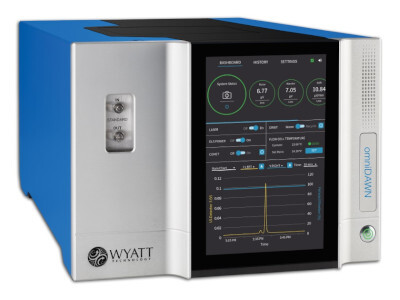
| Item | omniDAWN™ Multi-angle Light Scattering (MALS) Instrument | DAWN™ Multi-angle Light Scattering (MALS) Instrument | miniDAWN™ Multi-Angle Light Scattering (MALS) Detector for SEC-MALS |
| Citations | | | |
| Reviews | | | |
| Catalog Number | omniDAWN | DAWN | miniDAWN |
| Price | | | |
| Description | Delivering up to 4× faster runs with half the sample, the omniDAWN™ multi-angle static light scattering (MALS) photometer is purpose-built for UPLC™ and UHPLC systems for non-destructive absolute molar mass and size characterization of macromolecules and nanoparticles in solution. It provides Delivering up to 4× faster runs with half the sample, the omniDAWN™ multi-angle static light scattering (MALS) photometer is purpose-built for UPLC™ and UHPLC systems for non-destructive absolute molar mass and size characterization of macromolecules and nanoparticles in solution. It provides exceptional sensitivity across a broad range of molecular weights, sizes, and concentrations, supported by advanced analysis modules, practical implementation guides, and intelligent system health monitoring to ensure reliable performance and streamlined workflows.... Read More | The DAWN™ instrument is an advanced detector for precise characterization of proteins, polymers, and nanoparticles including viral vectors, lipid nanoparticles and vesicles. Using multi-angle static light scattering (MALS) and optional dynamic light scattering (DLS), DAWN analyzes molar massThe DAWN™ instrument is an advanced detector for precise characterization of proteins, polymers, and nanoparticles including viral vectors, lipid nanoparticles and vesicles. Using multi-angle static light scattering (MALS) and optional dynamic light scattering (DLS), DAWN analyzes molar mass, size, conformation, particle concentration, conjugation (e.g. glycoproteins) or encapsulation (e.g. AAV capsid content). It stands out with exceptional sensitivity and the widest range of molecular weight, size, and concentration of any MALS instrument, paired with a broad selection of configurations and optional modules for enhanced capabilities.
The DAWN is most often used in conjunction with gel permeation chromatography (GPC-MALS), size exclusion chromatography (SEC-MALS) or an EclipseTM, field-flow fractionation instrument (FFF-MALS) and may also be used with ion-exchange chromatography or reverse-phase chromatography. The instrument includes a high-resolution, touch-screen front panel to display data graphs, system health and instrument diagnostics and is accompanied by ASTRA™, the most versatile software package available for analysis of online multi-angle and dynamic light scattering.... Read More | Couple the miniDAWN™ to your favorite HPLC or FPLC to determine the absolute molar masses and sizes of macromolecules and nanoparticles in solution from hundreds to millions of Daltons—without the need for column calibration standards. This sensitive unit requires as little as 25 ng injected Couple the miniDAWN™ to your favorite HPLC or FPLC to determine the absolute molar masses and sizes of macromolecules and nanoparticles in solution from hundreds to millions of Daltons—without the need for column calibration standards. This sensitive unit requires as little as 25 ng injected sample, 100 kDa polystyrene in THF (varies for other samples and solvents). The miniDAWN is engineered with self-contained modules that are easily replaced making it field serviceable. The system-ready monitors soise levels in real-time and an all-green status indicator lets you know when your system is ready for data collection. The optional DLS module uses the WyattQELS™ module, which fits inside the miniDAWN to providing on-line dynamic light scattering for determining radii down to 0.5 nm. All light scattering cells are subject to contamination by particles and to combat this issue the instrument has a self-cleaning, embedded COMET™ ultrasonic module. For maximum reliability and uptime, program the miniDAWN to automatically clean the cell after every run. The units may also be combined with a Calypso™ composition-gradient system to characterize biomolecular interactions.... Read More |
| Temperature Range | Inquire | Ambient; Heated/Cooled (HC): -15°C to +150°C; Ultra-High-Temperature (UHT): ambient to +210°C | ambient |
| Radius of Gyration Range | Inquire | Rg (rms radius): 10 nm to 500 nm
Rh(hydrodynamic radius): 0.5 nm to 300 nm or up to 1 µM (with optional DLS module, upper limit configuration-dependent) | Rg (rms radius): 10 nm to 50 nm
Rh(hydrodynamic radius): 0.5 nm to 50 nm or up to 1 µM (with optional DLS module, upper limit configuration-dependent) |
| Get Quote | | | |