A rotational rheometer, also known as a shear rheometer, is an instrument used to determine how a liquid or slurry flows. Rotational rheometers can measure viscosity, thixotropy, shear stress, and shear strain. Used is the plastics, petroleum, cosmetic, food, and pharmaceutical industries, rotational rheometers help to maintain parameters such as consistency and fluidity, which in turn allow predictions to be made about stability, texture, and shelf life. Rotational rheometers apply a known force to the sample and measure how it reacts to the force and the force the sample then exerts on the rheometer.
Features that can vary between rotational rheometers include viscosity ranges measured, whether or not there is a built in temperature probe, and the user friendliness of the controls and read out screen.
Discover and compare Rotational Rheometers:
|  |  |
| Company | Waters Corporation | Waters Corporation |
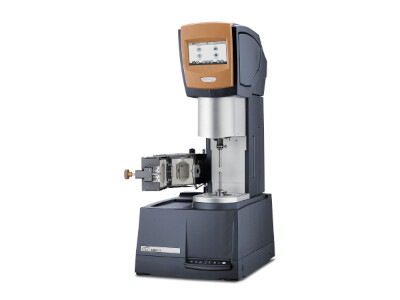
| Item | Waters TA Instruments™ ARES-G3™ Rheometer | Waters TA Instruments™ TA Instuments Moving Die Rheometer |
| Citations | | |
| Catalog Number | ARES-G3 | MDR One |
| Price | | |
| Description | The advanced Waters TA Instruments ARES-G3 Rheometer pushes rheology further, delivering sharper data across more conditions. Building upon 55 years of rheology innovation, the ARES-G3 Rheometer’s cutting-edge technology and precision hardware capture real fluid behavior with fewer adjustments and The advanced Waters TA Instruments ARES-G3 Rheometer pushes rheology further, delivering sharper data across more conditions. Building upon 55 years of rheology innovation, the ARES-G3 Rheometer’s cutting-edge technology and precision hardware capture real fluid behavior with fewer adjustments and more accurate outcomes.
The ARES-G3 Rheometer features a modular design and high-performance core, offering a scalable platform that evolves with research and quality control needs.
-
Faster workflows can accelerate routine testing and data procession, helping improve lab efficiency
-
Expanded testing capabilities add support for solid material testing and advanced viscoelastic measurements
-
Enhanced data acquisition help capture more detailed, simultaneous data for deeper material insights
-
Advanced control features enable complex deformation profiles and waveform customization for cutting-edge research
... Read More | The MDR one Moving Die Rheometer (MDR) is a reliable, accurate, and easy-to-operate rotorless curemeter perfect for routine and standards-driven testing of rubber curing. The MDR one is configured for measuring curing profiles of rubber compounds under isothermal and non-isothermal test conditions The MDR one Moving Die Rheometer (MDR) is a reliable, accurate, and easy-to-operate rotorless curemeter perfect for routine and standards-driven testing of rubber curing. The MDR one is configured for measuring curing profiles of rubber compounds under isothermal and non-isothermal test conditions at constant strain and frequency.The MDR one employs sealed biconical dies meeting all relevant ASTM, ISO, and DIN standards.The unique design includes an ultra-rigid test frame, direct drive motor, precision temperature control with optional cooling, available Autosampler, and intuitive Scarabaeus Control and Analysis software making it the ideal platform for QC or R&D environments.
Features: - Unmatched data precision, accuracy, and reproducibility
- Robust, field proven torque transducer for high stability and reliable torque measurements
- Extremely rigid test frame for accurate compliance free data
- Available autosampler for simple unattended operation
- Pneumatic locking cylinders for repeatable sample sealing
- Powerful and intuitive Scarabaeus Software available in multiple languages & compatible with other manufacturers’ instruments
- User calibration and user replaceable seals
... Read More |
| Torque Resolution | 1 nN.m | Inquire |
| Torque Range | 0.001 to 20 N | 0.001 to 20 Nm |
| Temperature Range | -150 °C to 600 °C (Forced Convection Oven, FCO),
-10 °C to 150 °C (Advanced Peltier System, APS) | Ambient to 230 °C |
| Frequency Range | 1 x 10⁻⁷ rad/s to 628 rad/s | Inquire |
| Frequency | Inquire | 0.1 to 2.0 Hz (6 to 120 cpm) |
| Get Quote | | |