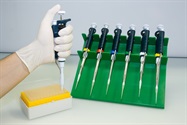
Pipets and pipettors are used to transfer or measure set volumes of liquid, ranging from 0.1 µL to 10 mL. Start by choosing a displacement method: Air-displacement pipets are often recommended for aqueous samples since there is always an air cushion (dead volume) between the sample and the piston. Samples that are viscous, radioactive, corrosive, or volatile tend to require a positive-displacement pipet, which has a disposable piston and direct piston–sample contact. No air cushion means more accurate pipetting of high-density samples. Next, choose manual versus electronic operation. Manual pipettors tend to be very durable and easily maintained, while electronic pipettors have the advantage of increased accuracy, reduced force, and a lower risk of repetitive stress injuries. Repeating electronic pipets are useful in biochemistry, microbiology, and immunology. Single-channel pipets are workhorses in liquid handling; multichannel pipets are common in PCR and ELISA applications, with the number of channels ranging from 4 to 64.
Discover and compare Pipets and Pipettors:
Get Quote for All
Select up to 5 products from below to compare or request more information.
Gilson Inc
- 0.2 µL to 10 mL
- Lab supplies & consumables
Gilson Inc
- 0.2 µL to 10 mL
- Lab supplies & consumables
Gilson Inc
- 0.2 µL to 10 mL
- Lab supplies & consumables
Gilson Inc
- 0.5 µL to 10 mL
- Lab supplies & consumables
Select up to 5 products from above to compare or request more information.
Tags:
Please Login or Register to Create Tags