The polymerase chain reaction (PCR) has become such a ubiquitous technology that professionals from a wide variety of disciplines have begun to depend on it. When selecting a PCR thermal cycler there are three key variables to consider: the number of wells available, the temperature gradient range, and programmability. The number of wells available determines the number of combinations of temperature gradients, MgCl2 concentrations and primer levels, which are the three parameters that determine amplification optimization. Within this matrix, the temperature gradient is a key feature in optimization especially when using heterologous primers. The thermocyclers showcased herein typically offer a maximum gradient temperature range 15 – 30° C. Gradient thermal cyclers vary in temperature ramp speed between cycling steps as well as temperature stability and heated lid control. Other specifications include ease-of-use in programmability and the ability to store programs as part of method development for all basic PCR applications, including molecular cloning and sequencing, diagnostics and forensic analysis.
|  |  |
| Company | Analytik Jena | Analytik Jena |
| Item | qTOWER iris Series | Biometra TRobot II – Automated Thermal Cycler |
| Catalog Number | qTOWER iris Series | Biometra TRobot II |
| Price | | |
| Temperature Range | 4 °C to 99 °C | 3 °C to 99 °C |
| Capacity | 9 or 384 well | 96 and 384 well |
| Gradient Temperature Range | Inquire | 10 °C to 99 °C depending on model |
| Max. Gradient Range | Inquire | 18 °C to 30 °C depending on model |
| Heated Lid | 30 °C to 110 °C | 30 °C–110 °C |
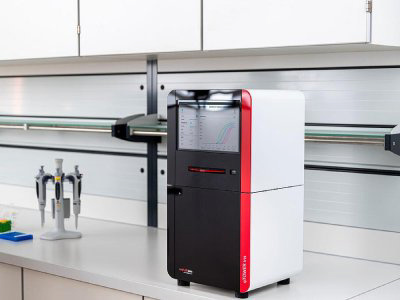
| Description | The Real-time PCR Thermocycler qTOWER iris empowers your exploration. It equips you to meet your current and future needs in qPCR, as a truly open system: You are free to choose what it takes for your venture – from consumables, assays, to color modules. The instrument can hit six targets at once. The Real-time PCR Thermocycler qTOWER iris empowers your exploration. It equips you to meet your current and future needs in qPCR, as a truly open system: You are free to choose what it takes for your venture – from consumables, assays, to color modules. The instrument can hit six targets at once. And for your peace of mind, you can count on a system designed for long-term use that operates quietly and smoothly, providing uniform precision across every well.
Precision in Each Well: The target temperature is precisely reached during heating and cooling, without overshooting or undershooting, preventing false amplification (artifacts). There are also no edge effects; thanks to uniform temperature distribution across the entire block, the deviation is ±0.15 degrees Celsius, compared to the market standard of ±0.4 degrees. This also applies to readout results: Since the fiber optic advances column by column, it reads each well from the same angle, unlike camera optics.
Faster Assay Completion:The Linear Gradient Tool allows for the testing of various temperatures column-wise in the same run, with twelve temperature ranges for the 96-well block (24 for the 384-well block). The gradient function spans up to 40°C for the 96-well block or 24°C for the 384-well block, and can be adjusted in increments of at least 0.1°C.... Read More | In addition to standard polymerase chain reaction (PCR), the Biometra TRobot II is also suitable for all other molecular biological or chemical incubations in PCR plates. For example, the generation of libraries for Next Generation Sequencing (NGS) is an important step in a larger workflow where theIn addition to standard polymerase chain reaction (PCR), the Biometra TRobot II is also suitable for all other molecular biological or chemical incubations in PCR plates. For example, the generation of libraries for Next Generation Sequencing (NGS) is an important step in a larger workflow where the automated thermal cycler can be used. This reduces the manual effort and the possibility of errors.
The Biometra TRobot II automated PCR machine has outstanding heating and cooling rates and excellent temperature homogeneity across the sample block for highly reproducible PCR results. For the setup of new protocols, or for the transfer of existing protocols from other thermal cyclers, it is sometimes necessary to make slight optimizations to the protocols. For this purpose, the Biometra TRobot II includes a gradient function – making it possible to test different temperatures in the critical annealing step of the PCR in one run.
... Read More |
| Gradient Capability | Linear Gradient Tool | Yes, over 12 rows or 24 rows depending on model |
| Get Quote | | |