Like conventional microplate readers, multimode microplate readers detect reaction signals from microtiter plates in order to perform assays such as ELISA, protein detection, and drug screening assays. Unlike conventional plate readers, multimode microplate readers are able to perform two or more forms of detection allowing a single piece of equipment to perform a wider range of assays. This can increase throughput and efficiency, thus saving time and space in the lab. Important things to consider when purchasing a multimode microplate reader are the particular combinations of assays desired, ease of use, ability to add or remove functionality, and the unit price.
Find, compare, and request a quote for multimode microplate readers across leading suppliers at Labcompare; including access to product citations, related published figures, and first-hand reviews from our scientific community.
|  |  | 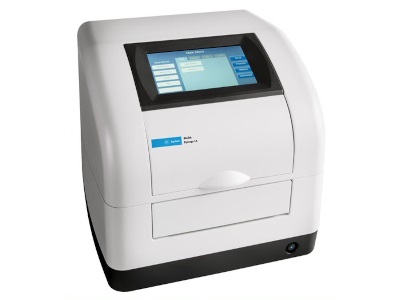 |
| Company | Agilent Technologies | Agilent Technologies | Agilent Technologies |
| Item | BioTek Epoch 2 Microplate Spectrophotometer | Agilent BioTek Synergy H1 Multimode Reader | Agilent BioTek Synergy LX Multimode Reader |
| Citations | | | |
| Figures | | | |
| Reviews | | | |
| Catalog Number | Epoch 2 | Synergy H1 | Synergy LX |
| Price | | | |
| Description | The Agilent BioTek Epoch 2 microplate spectrophotometer delivers excellent performance for UV-Vis absorbance measurements. Measurements can be performed in 6- to 384-well microplates, cuvettes, and in microvolume samples with the available Take3 microvolume plate. The broad wavelength range enables The Agilent BioTek Epoch 2 microplate spectrophotometer delivers excellent performance for UV-Vis absorbance measurements. Measurements can be performed in 6- to 384-well microplates, cuvettes, and in microvolume samples with the available Take3 microvolume plate. The broad wavelength range enables applications from nucleic acid and protein quantification in the low UV to microbial growth assays higher wavelengths.;Epoch 2 is easy to use and the optional touch screen interface makes it simple to choose predefined protocols or to define custom programs. The Agilent BioTek Gen6 data analysis software brings additionally functionality with its predefined experiments and powerful data analysis tools. Endpoint, kinetic, spectral scanning and well area scanning modes, plus incubation and shaking enable wide-ranging applications.... Read More | Agilent BioTek Synergy H1 is a modular multimode microplate reader, with monochromator-based optics and filter-based optics. The proprietary Hybrid Technology offers flexibility and sensitivity across a broad range of applications. The modular platform allows upgrading to expand functionality as Agilent BioTek Synergy H1 is a modular multimode microplate reader, with monochromator-based optics and filter-based optics. The proprietary Hybrid Technology offers flexibility and sensitivity across a broad range of applications. The modular platform allows upgrading to expand functionality as your laboratory workflows change. Synergy H1 offers continuously variable bandwidth monochromators for fluorescence excitation and emission wavelength selection. Fluorescence bandwidth can be set between 9 and 50 nm, in 1 nm increments, allowing users to fully optimize reader settings to drive the best assay performance compared to fixed bandwidth systems.... Read More | The Agilent BioTek Synergy LX multimode reader automates many common microplate assays. The high-quality optic design ensures excellent data in absorbance, fluorescence, and luminescence detection modes. This affordable system is ideal for many common assays including nucleic acid and protein The Agilent BioTek Synergy LX multimode reader automates many common microplate assays. The high-quality optic design ensures excellent data in absorbance, fluorescence, and luminescence detection modes. This affordable system is ideal for many common assays including nucleic acid and protein quantification, ELISA, BCA, Bradford, and cell viability. Gen6 data analysis software provides complete reader control and data analysis, and includes many pre-defined experiments, ready to customize for your assays. Synergy LX is available with a large touch screen user interface and onboard software for endpoint measurements and analysis.... Read More |
| Reading Modes | UV-Visible Absorbance | Fluorescence, Time-Resolved Fluorescence, Luminescence, UV-Visible Absorbance and more | UV-Vis absorbance, Fluorescence intensity, Luminescence |
| Optical System | Monochromator | Monochromator or Filter/Dichroics-based | Monochromator or Filter-based |
| Wavelength Range | 200 to 999 nm | 230 to 999 nm (depending on model) | 200 nm to 999 nm, in 1 nm increments (Absorbance)
320 to 700 nm (low noise PMT), 320 to 850 nm (red-shifted PMT) |
| Plate Formats | 6- to 384-well plates | 1 to 384 Well Plates | 6 to 384-well plates |
| Temperature Control | 4-Zone™ incubation to 65 °C | up to 45°C | Inquire |
| Get Quote | | | |