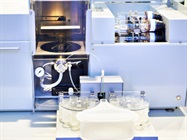
Atomic absorption spectroscopy is a common method of quantifying elemental concentrations in a sample typically at ppb-ppm concentrations. Flame atomic absorption spectroscopy operates similarly to other AASs by passing a specific wavelength of light through the sample and measuring the amount of light absorbed (atomic absorption), however, where it differs is that to dissociate ground state atoms it utilizes a flame as the heat source. Flames are typically fueled by either nitrous oxide (N
2O) or acetylene (C
2H
2) in a flame AAS, however in some instances other fuel sources may be used. Flame AAS is a great balance between cost and detection limits and can tolerate more complex matrices than other elemental testing instruments while being user-friendly and reliable. High-throughput laboratories should consider a flame AAS that can utilize multiple hollow cathode lamps to analyze numerous elements sequentially during analysis.
Get Quote for All
Select up to 5 products from below to compare or request more information.
Agilent Technologies
- Flame/Hydride and Graphite Furnace
- 185-900 nm range
- UltrAA Lamps
Agilent Technologies
- Flame
- 185 to 900 nm
- Hollow-Cathode and Deuterium
Agilent Technologies
- Flame
- 185 to 900 nm
- Hollow-Cathode and Deuterium
Select up to 5 products from above to compare or request more information.
Tags:
Please Login or Register to Create Tags