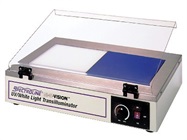
An ultra-violet (UV) transilluminator is a standard piece of equipment used in life science laboratories for visualization of target DNAs and proteins. Sometimes referred to as a gel light box or lab light box, the UV transilluminator works by emitting high levels of UV radiation through the viewing surface. The key application for a UV transilluminator is for visualization of DNA and protein agarose and polyacrylamide gels after electrophoresis. Gels can be directly placed onto the UV transilluminator; wavelength will vary on your particular application. Some considerations to keep in mind when shopping around for a UV transilluminator include viewing surface size for varying size gels; wavelengths, as some models come in single or dual wavelengths; and the dimensions of the benchtop unit.
Get Quote for All
Select up to 5 products from below to compare or request more information.
Major Science
- Inquire
- 200 x 200 x 13.9 mm (W x L x H)
- Inquire
Major Science
- Inquire
- 86 x 170 x 25 mm (W x L x H)
- Inquire
Major Science
- Inquire
- 200 x 200 x 15.6 mm (W x L x H)
- Real-time observation of nucleic acids, proteins or X-ray film
Major Science
- Inquire
- 340 x 286 x 176 mm (W x L x H)
- Fluorescence examination of nucleic acid bands under blue or UV light
Major Science
- 6 tubes, 8 W/tube
- 340 x 295 x 100 mm (W x L x H)
- Gel viewing and back-illumination of transparent fluorescent materials; 254 nm mode for sample irradiation
Select up to 5 products from above to compare or request more information.
Tags:
Please Login or Register to Create Tags