August 23, 2012 – Over the last 50 years, the spotting of newborn’s blood onto filter paper for disease screening, called Guthrie cards, has become so routine that since 2000, more than 90% of newborns in the United States have had Guthrie cards created. In a study published online in Genome Research (www.genome.org), researchers have shown that epigenetic information stored on archived Guthrie cards provides a retrospective view of the epigenome at birth, a powerful new application for the card that could help understand disease and predict future health.
DNA methylation, an epigenetic chemical modification of DNA, is known to affect gene activity and play a role in normal development, aging, and also in diseases such as heart disease, diabetes, and cancer. “But are these epigenetic marks involved in causing the disease, or a result of the disease itself?” asked Dr. Vardhman Rakyan of Queen Mary, University of London and co-senior author of the study. Rakyan explained that this is impossible to know when samples are obtained after onset of the disease. Guthrie cards, commonly used to collect blood spots from the pricked heel of newborns to screen for diseases such as phenylketonuria, cystic fibrosis, and sickle cells disorders, might offer a snapshot of the epigenome before disease develops. Many Guthrie cards are stored indefinitely by health authorities around the world, posing a potential wealth of information about the epigenome at birth.
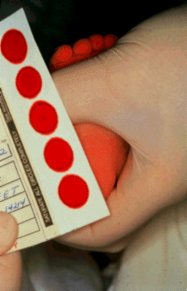
Rakyan and an international group of colleagues purified genomic DNA and analyzed DNA methylomes from Guthrie cards and verified that this archived DNA yields high-quality methylation data when compared to fresh samples. The researchers then compared the DNA methylation profiles of newborns to the same healthy individuals at the age of three, looking for epigenetic variations detected in the Guthrie card sample that are stable into the early years of life.
“We found similar epigenetic differences between different people both at birth and when they were three years old,” said Rakyan, who added that these differences, already present at birth, are unlikely due solely to inherent genetic differences between the individuals, but also due to environment or random events in utero. Furthermore, Guthrie card samples could be analyzed for both genetic and epigenetic differences together to view a more complete picture of the genome at birth.
Guthrie card methylomics is a potentially powerful new application for archived blood spots, which could provide a wealth of information about epigenetics and disease, and could give clues about health later in life. Dr. David Leslie, co-senior author of the study, added that because national health authorities routinely make Guthrie cards available, and with the proper consent obtained from parents and children, “we are talking about an invaluable, and non-renewable, resource for millions of individuals.”
Scientists from Queen Mary, University of London (London, UK), the University of Cambridge (Cambridge, UK), the University of Oxford (Oxford, UK), Skåne University Hospital (Malmö, Sweden), and University Medical Center Ulm (Ulm, Germany) contributed to this study.
This work was supported by The Knut and Alice Wallenberg Foundation, the Swedish Research Council, the Skåne County Council for Research and Development, the Biotechnology and Biological Sciences Research Council (UK), Juvenile Diabetes Research Foundation International, the Multiple Sclerosis Society of the United Kingdom, and the Medical Research Council (UK).
Media contacts:
The authors are available for more information by contacting Emma Mason, Public Relations Manager for the School of Medicine and Dentistry at Queen Mary, University of London ([email protected] ; +44 20 7882 7943).