Explorer® One™ pulsed UV lasers ideal for micromachining and bioinstrumentation
Santa Clara, CA – May 13, 2013 –Spectra-Physics®, a Newport Corporation brand, introduces Explorer One, the world’s smallest, actively Q-switched diode-pumped solid-state (DPSS) ultraviolet (UV) lasers. The unique “It’s in the Box™” design combines laser resonator and control electronics into a single housing, making Explorer One the most compact and lightweight UV laser in its class. Explorer One lasers are targeted for a variety of applications such as MALDI-TOF mass spectrometry, laser microdissection, UV plastics marking, stereolithography, FPD repair, and other tasks that require premium performance and extreme durability in a tiny footprint.
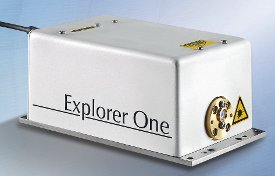
“Product simplicity, flexibility, and low cost of ownership are key advantages of Explorer One lasers and, in fast-changing markets, these are critical for product leadership”, says Wolfgang Koehler, product manager of Spectra-Physics Stahnsdorf. “The Explorer One is the world’s smallest actively Q-switched DPSS laser - at least 8 times smaller than any competitive product. The feature-rich software algorithms enable simple system integration and ensure a fast return on engineering investment.”
This first generation of Explorer One lasers will be available in two versions at 349 and 355 nm wavelengths. Explorer One 349-120 delivers a high pulse energy of >120 µJ at 1 kHz repetition rate. Explorer One 355-300 delivers >300 mW output power at 50 kHz repetition rate. Both lasers have short pulse widths (<5 and <8 ns, respectively) and low pulse energy noise (< 2% and < 3%, respectively) for ultra-stable processes and highest production yields.
The rugged and miniature Explorer One weighs less than 1.5 kg and has been tested to endure bare product shock and vibration with accelerations of up to 100 g, making it suitable for use on moving gantries. The laser is based on Spectra-Physics’ field-proven Explorer platform with demonstrated high reliability from thousands of units deployed in demanding 24/7 applications.
Spectra-Physics’ Explorer One lasers will be featured at LASER World of Photonics in Munich, Germany, May 13-16, 2013. Please visit Newport's booth #560 in Hall B1 for a demonstration. For more information, please visit: www.newport.com/explorer-one.
About Newport Corporation
Newport Corporation is a leading global supplier of advanced-technology products and systems to customers in the scientific research, microelectronics manufacturing, aerospace and defense/security, life and health sciences and precision industrial manufacturing markets.
Newport’s innovative solutions leverage its expertise in high-power semiconductor, solid-state and ultrafast lasers, photonics instrumentation, sub-micron positioning systems, vibration isolation, optical subsystems and precision automation to enhance the capabilities and productivity of its customers’ manufacturing, engineering and research applications. Newport is part of the Standard & Poor’s SmallCap 600 Index and the Russell 2000 Index.
Company Contacts:
Elizabeth Peartree
Sr. Marketing Communications Manager
Tel: +1 408-980-4305
Email: [email protected]
Wolfgang Köhler
Product Manager
Tel: +49 3329-638722
Email: [email protected]