[LITTLETON, MA – JANUARY 2012]“Our goal at the 2012 Pittcon Conference & Expo,” says Spectro, Inc. President and CEO Brian Mitchell, “is to introduce Spectro’s broad and analytically significant technology platforms to a much wider marketplace. The company has built a strong and differentiated market position in the field of oil and lubricant analysis where its products are considered the ‘gold standards’. It is evident that Spectro has the potential to reach substantially larger end user markets with its lab, field portable, and hand-held analytical tools which are based on emission, infrared, FTIR and X-ray technologies among others. Coupled with the company’s proprietary calibrations, algorithms, and LIMS software platforms, Spectro hopes to engage prospective customers and OEM partners in meaningful discussions as to how its capabilities might provide the same powerful ROI advantages that it has demonstrated in the tribology markets. My prior experience as the CEO of Polychromix (prior to its acquisition by Thermo Fisher Scientific, NYSE; TMO in May 2010) taught me the importance of targeting those particular applications where real time and actionable information enabled by portable and hand-held technologies is of great importance and value to the customer. It is in these arenas that
Spectro has invested significantly in developing new innovations to meet the needs of its customers who have difficult challenges sampling fluids in the field – both lubricating and process. As an example, Spectro recently introduced the flip top sampling cell, which is a patented tool that allows infrared measurement of fluids or solids with the ease of use of an ATR (attuenated total reflectance) cell and the sensitivity of a transmission cell. This approach greatly simplifies sampling for infrared measurement, improves accuracy, and allows chemometrics to be performed on location at the application site. At Pittcon, Spectro will demonstrate a direct infrared handheld spectrometer, FluidScan, which uses a patented optical wedge design, developed for rugged environments where moving parts are not desired. Infrared measurement is in the 950 to 4,000 cm-1 range. The technology optimizes the infrared measurement into specific regions with high sensitivity within the mid infrared range. Though currently aimed at petroleum applications, it is possible to optimize the measurement for other purposes such as pharma, food and beverage, process control, and industrial chemicals analysis.
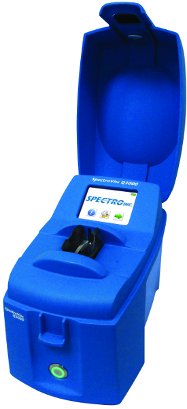
Measuring viscosity of Newtonian fluids in the field solvent-free has been an industry challenge that Spectro has overcome with its patent-pending split cell capillary viscometer technique. The recent introduction of its “Q3000” viscometer, also to be exhibited at Pittcon, opens up the possibilities of industries and environments being able to measure kinematic viscosity at a fixed temperature (40 degrees C) on fluids for quality control or condition monitoring purposes. “The number one benefit of the Q3000 is solvent-free kinematic viscosity measurement,” says Dan Walsh, Spectro, Inc.’s Director of Product Management. This is the clear advantage over other products on the market. Viscosity tests could never be done on location in a convenient way before because solvents, and the capabilities to handle them, were required to clean the measuring device.”
For more information, please visit Pittcon 2012 booth 1573 or contact Spectro, Inc. Littleton, MA, (978) 486-0123, www.spectroinc.com.