A research team offers a novel solution to understanding large-scale brain-wide interactions with their super high-speed microscope—two-photon fluorescence microscope, which has successfully recorded the millisecond electrical signals in the neurons of an alert mouse. The result of this ground-breaking work has recently been published in the journal Nature Methods.
At the heart of the high-speed microscope is an innovative technique called FACED (free-space angular-chirp-enhanced delay imaging) - developed by Tsai's team earlier. FACED makes use of a pair of parallel mirrors which generate a shower of laser pulses to create a super-fast sweeping laser beam at least 1,000 times faster than the existing laser-scanning methods.
In the experiment, the microscope projected a beam of sweeping laser over the mouse's brain and captured 1,000 to 3,000 full 2D scans of a single mouse brain layer (of the neocortex) every second. To probe the genuine electrical signals that pulse between the neurons, the team inserted a biosensor (protein molecules), developed by Michael Lin of Stanford University, into the neurons of the mouse brain.
"These engineered proteins will light up (or fluoresce) whenever there is a voltage signal passes through the neurons. The emitted light is then detected by the microscope and formed into a 2D image that visualises the locations of these voltage changes," said Tsia. "This is really an exciting result as we now can peek into the neuronal activities, that were once obscured and could provide the fundamental clues to understanding brain functions and more importantly brain diseases."
The researchers say they are working to further combine other advanced microscopy techniques to achieve imaging at higher resolution, wider view and deeper into the brain in the neocortex, which is about 1 millimeter.
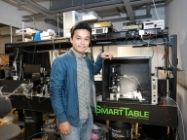
Photo: Kevin Tsia, Associate Professor of the Department of Electrical and Electronic Engineering and Programme Director of Bachelor of Engineering in Biomedical Engineering of the University of Hong Kong (HKU). Credit: The University of Hong Kong