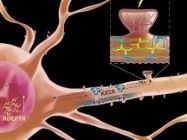
A new study from scientists at Scripps Research and the Max Planck Florida Institute for Neuroscience finds a central role in neural plasticity for one signaling molecule, a long, noncoding RNA that the scientists named ADEPTR.
Using a variety of technologies, including confocal and two-photon microscopy, they track ADEPTR's moves, watching as it forms, travels, amasses at the synapse and activates other proteins upon a neuron's stimulation.
Its journey to the far reaches of a brain cell is made possible by a cellular carrier that that tiptoes along a dendrite's microtubule scaffolding. Called a kinesin motor, it deposits ADEPTR near the synapse junction, where it activates other proteins.
The team also found that if ADEPTR is silenced, new synapses don't form during stimulation.
"Here we report activity-dependent dendritic targeting of a newly transcribed long noncoding RNA for modulating synapse function, and describe its underlying mechanisms," says the study's lead author, Scripps Research neuroscientist Sathyanarayanan Puthanveettil. "These studies bring novel insights into the functions of long noncoding RNAs at the synapse."
The work is revealing one of the most fundamental processes of learning and memory, adaptation to changing information and circumstances.
"Neural plasticity is what allows us to learn, respond to stimuli, and lay down long-term memories," Puthanveettil says. "There is still much to learn about the magnificent complexity of this fundamental biological process."
Photo: Synaptic activation promotes a signaling cascade that results in the expression of long noncoding RNA, ADEPTR. Credit: Jenna Wingfield and Yibo Zhao of the Puthanveettil lab at Scripps Research in Jupiter, Florida.