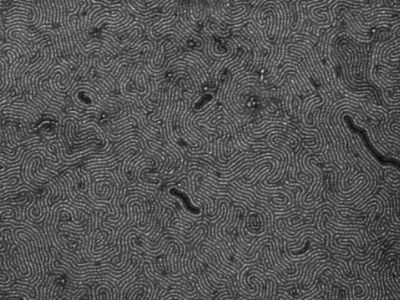
University of Wisconsin-Madison researchers fabricated graphene into the smallest ribbon structures to date using a method that makes scaling-up simple.
By constructing ribbon-shaped polymers on top of graphene and then etching away some of the surrounding material, the researchers were left with precisely drawn, impossibly thin ribbons of graphene. They then shined different wavelengths of infrared light into the structures and identified the wavelength where the ribbons and light interacted most strongly, known as the resonant wavelength.
The team compared their experimental data to the predicted behaviors of structured graphene across three different ribbon widths and three electric field strengths. The wider ribbons the researchers created closely matched the predicted behaviors. But for narrower ribbons, they saw a so-called blueshift, or a shift to higher-than-expected energies.
"The blueshift we observed indicates that telecommunications wavelengths can be reached with much larger structures than previously expected—around eight-to-10 nanometers—which is only marginally smaller than the 12 nanometers structures we made," Siegel says.
With the eight-to-10 nanometer goal much closer than expected, the researchers are now trying to tweak their fabrication methods to make the ribbons even narrower.
Photo: The structures, which act like tiny antennas that interact with light, are too small to see with the naked eye.
Credit: Study Authors/University of Wisconsin–Madison