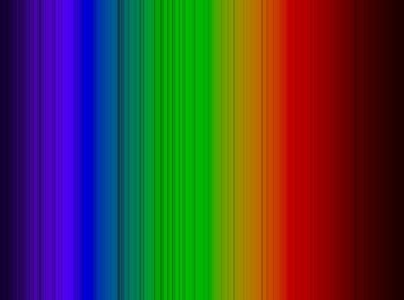
The solar spectrum. The two strongest silver lines, highlighted in white, lie in the ultraviolet region that is invisible to the human eye. Credit: Anish Amarsi/Uppsala University
The sun contains 55 percent more silver than previous estimates suggested, according to new research from Uppsala University that resolves a decades-old mystery about missing silver in the solar system.
Like most stars, the sun is made up almost entirely of hydrogen and helium, with heavier elements such as carbon, iron and silver making up just 1.5 percent of its mass. Despite their scarcity, these trace elements serve as a kind of fossil record, revealing how stars and planets form and evolve over cosmic time.
For the study, published in Astronomy and Astrophysics, researchers used spectroscopy to analyze sunlight, examining the dark absorption features that atoms in the sun's atmosphere create when they absorb light.
The fingerprint is then compared with calculated atmospheric models to quantify the abundance of silver in the sun. Previous estimates were based on simplified models. However, in this study, the researchers developed a new model that predicts 55% more silver than before. They combined a dynamical model of the sun’s outer layers with improved atomic physics calculations to capture how silver atoms interact with light and other particles. Unlike earlier methods, the new calculations include non-equilibrium effects, meaning that the light influences the same silver atoms that create the dark absorption lines.
Beyond settling the solar silver discrepancy, the findings sharpen scientists' understanding of how silver and other heavy elements form during stellar explosions and get passed on to future generations of stars and planets. Researchers now plan to apply the same modeling approach to stars beyond the Sun.
“By studying the light of stars of different types and ages, we hope to understand where silver is formed in the universe, and how it has been distributed throughout the Milky Way over time,” said Sema Caliskan, who conducted the work during her PhD studies at Uppsala University.
Data from Uppsala University