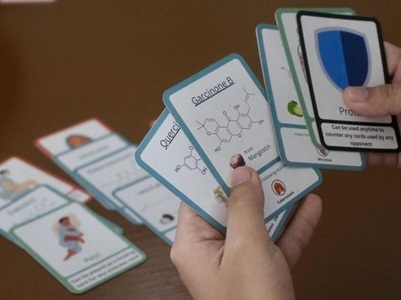
The Herbularyo game. Credit: Ateneo de Manila University
Filipino folk healers, or albularyo, have long relied on medicinal plants passed down through oral tradition—tawa-tawa for dengue, aloe vera for scrapes, boiled guava leaves to disinfect wounds, yerba buena for aches, and ampalaya for managing diabetes. While these remedies are widely recognized across the Philippines, the chemistry behind them is far less familiar, even though it's grounded in real scientific research.
To bridge the gap, researchers at Ateneo de Manila University have created an educational card game that teaches organic chemistry concepts by drawing on traditional Filipino herbal medicine. Classroom testing shows it significantly boosts student learning.
The game, called Herbularyo, incorporates familiar Filipino cultural concepts into its gameplay. Each player takes on the role of a traditional healer racing to cure illnesses using cards featuring medicinal herbs and their active compounds. Special cards inspired by binat (relapse), sumpa (curse), and himala (miracle) add strategy and reflect beliefs that are deeply embedded in Philippine folk healing traditions.
As the game progresses, players match herbs with illnesses and identify the organic compounds found in each plant. In the process, the gameplay reinforces organic chemistry concepts through interaction rather than memorization.
In testing with high school and college students, those who played the game showed significantly greater learning gains, and also described the experience as engaging and enjoyable.
“We wanted to make a game that not only teaches organic chemistry and Filipino traditions, but also how these areas of knowledge can inform each other,” said Herbularyo co-developer Maryjane Magsino. “We wanted to underscore the value of traditional Filipino medicine that has stood up to scientific testing yet is within easy reach practically in our own back yards.”
Herbal remedies remain especially important in rural and underserved Filipino communities, where they continue to complement conventional care. The researchers hope Herbularyo encourages a new generation of students to see science in the plants around them—and, in turn, helps make complementary and traditional remedies more broadly understood and accessible.
Data from Ateneo de Manila University