Credit: Melvil
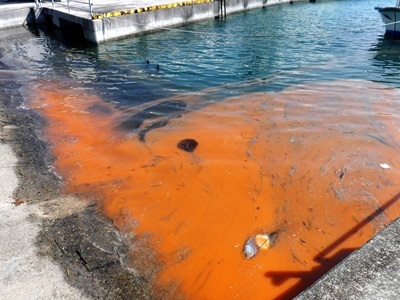
Vacationers headed to the Pacific Coast to enjoy sun and sand time can be caught off guard when they arrive only to find blood red water and dead marine life littering the shore. This phenomenon, known as red time, occurs when there is an overgrowth or population boom of algae in water that is warm and calm—like the Pacific Ocean.
Beyond being unsightly, red tide algal blooms release a powerful neurotoxin, called saxitoxin (STX), that creates airborne toxins, kills marine life and can make humans sick on contact. If humans eat shellfish from a red tide, STX can even be fatal. STX is so dangerous, in fact, that it was stockpiled as a chemical weapon during the Cold War. In 2026, there is still no antidote for the toxin.
Now, researchers at UC San Francisco are one step closer to changing that. The team discovered that the saxiphilin protein, which occurs naturally in frogs, can neutralize STX in mice, preventing and even reversing lethal poisoning.
With harmful algal blooms becoming more frequent worldwide, the discovery could have important public health implications.
The frog protein
This work builds on a 2021 study in which the UCSF team became the first to show that saxiphilin binds strongly to saxitoxin in laboratory conditions. This time, the researchers wanted to know whether that interaction would hold up inside a living organism.
For the study, published in Nature Communications, researchers exposed mice to lethal doses of STX. When saxiphilin was administered before or alongside the toxin, it prevented poisoning entirely. When given afterward—the scenario that most closely mirrors someone unknowingly eating contaminated shellfish—it cured nearly all of the affected mice.
That result surprised the team, given the size of the two molecules involved.
“We had this really big protein that needed to catch up with a tiny toxin molecule that has a running start on it. We really weren’t sure this was going to work,” said lead researcher Daniel Minor, professor in UCSF's Cardiovascular Research Institute.
Saxiphilin not only improved survival but also reduced symptoms associated with severe poisoning, with no harmful side effects. Minor and team also discovered that saxiphilin spread throughout the body, reaching the brain, heart and muscles, allowing it to intercept the toxin wherever it traveled.
Old research, new antidote
Previous attempts to develop an antidote to STX focused on disrupting the biological processes it uses to disable nerve cells or on triggering an immune response against it. Minor's approach, however, takes a different route by directly neutralizing the toxin.
The discovery has roots in UCSF research from the late 1920s and 1930s, when physician-scientist Hermann Sommer investigated shellfish poisoning outbreaks along the California coast. Sommer determined that the toxin originated from microorganisms associated with shellfish rather than the shellfish themselves, laying the groundwork for the eventual identification of saxitoxin. He also noted that certain frogs seemed resistant to the toxin, an observation the new study effectively confirms nearly a century later.
Researchers now know that STX is not a single compound but a family of more than 50 closely related variants. In two additional studies, published in 2025 and 2026, Minor showed that saxiphilin can bind to a wide range of these variants, strengthening its case as a broad-spectrum antidote candidate.
“This was a problem looking for a solution,” Minor said. “It turns out that one naturally occurring protein is all that's required to take this toxin out of commission. Nature has had to solve this problem multiple times, so there is resilience to toxins all over the biological world.”
Next, Minor and team plan to determine whether smaller, engineered versions of saxiphilin could provide the same, or maybe even better, protection against an array of STX variants. More broadly, Minor said he believes the work offers a blueprint for finding antidotes to many other natural toxins that currently have none.